aureliobruno©2023
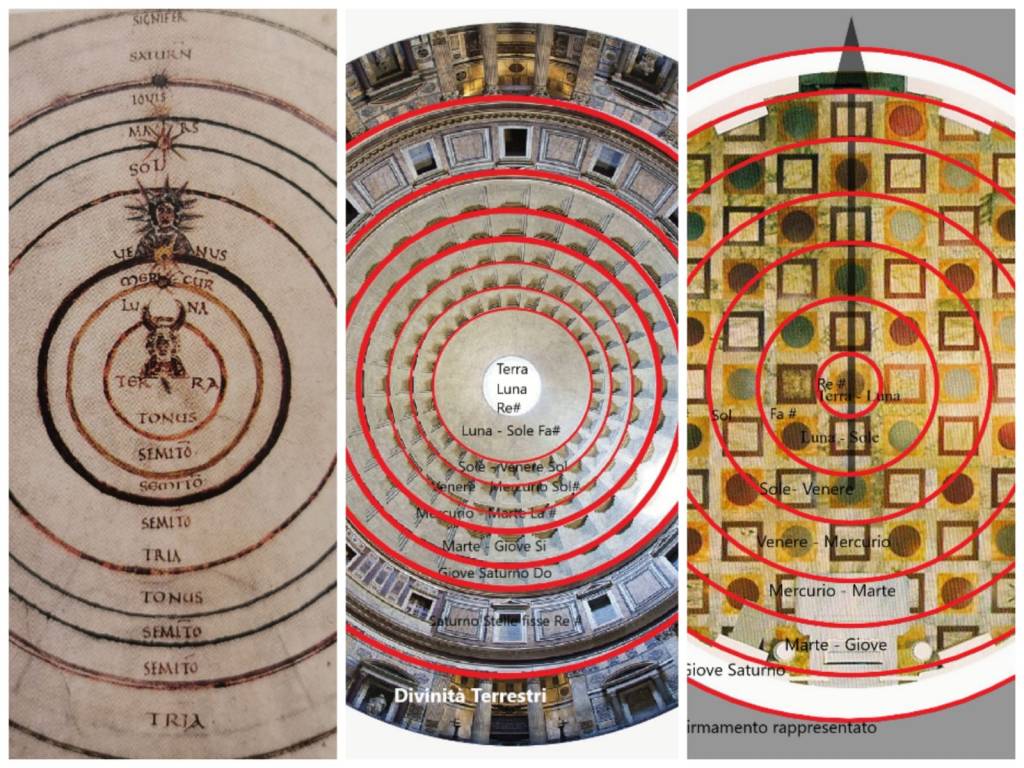
COSMIC MUSIC IN THE MYTH OF ER
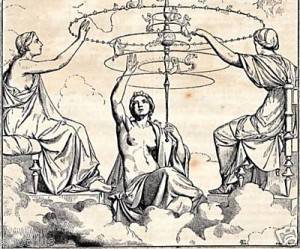
We now report in full the Platonic myth of Er, contained in Book X of The Republic:
All the groups of souls, after having spent seven days in the meadow, at the eighth had to get up and leave from there, to arrive after four days in a place from where they could see, stretched from above along all Heaven and Earth, a light straight as a column, much like the rainbow, but brighter and purer. After a day of walking, they arrived there and saw in the center of the light the ends of the chains that hung from Heaven; this light in fact held Heaven together and embraced its entire orbit, like the ropes that wrap the keel of the triremes. At those ends hung the whorl of Ananke, which gave rise to all the rotational motions; the rod and hook were made of steel, and the whorl was a mixture of this and other metals. The nature of the whorl, which in the form was similar to the one used here below, was the following: according to the description that Er made of it, we must imagine a large hollow whorl, completely emptied inside, in which another smaller one was embedded, such as the boxes that fit one inside the other, and so a third, a fourth and four more. Altogether there were therefore eight whorls, wedged one into the other: at the top, you could see the edges, similar to circles, which formed the continuous back of a single whorl around the shaft; the latter was stuck from side to side inside the eighth. The first whorl, the outermost one, had the widest circular edge; then came, in decreasing order of width, the sixth, fourth, eighth, seventh, fifth, third, and second. The edge of the largest whorl was variegated, that of the seventh the brightest, that of the eighth received its color from the seventh, which illuminated it, the edges of the second and fifth, very similar to each other, were more yellow than the previous ones, the third had a very white color, the fourth reddish, the sixth was second in whiteness. The whorl turned everything on itself with uniform motion, and in the overall rotation the seven inner circles slowly turned in the opposite direction to the whole: the eighth was the fastest, followed by the seventh, sixth and fifth, which proceeded together; in this retrograde motion the fourth circle seemed to those souls third in speed, the third seemed fourth and the fifth second. The whorl rotated on Ananke’s lap. Above each of those circles, a Siren moved, emitting a single note of a single tone, but from all eight a single harmony rang out. Three other women sat in a circle at equal distances, each on their own throne: they were the Moirae daughters of Ananke, Lachesis, Clotho, and Atropos, dressed in white and with their heads girded with bandages; on the harmony of the Sirens Lachesis sang the past, Clotho the present, Atropos the future. Clotho with his right hand touched at intervals the outer circle of the whorl and helped it to turn, and the same was done by Atropos touching the inner circles with his left; Lachesis accompanied both movements, now with one, now with the other hand. As soon as they arrived, they immediately had to present themselves to Lachesis. First, a herald lined them up, then he took the fates and models of life from Lachesis’s knees, went up to a high platform, and said: “Proclamation of the virgin Lachesis, daughter of Ananke! Ephemeral souls, here is the beginning of another cycle of mortal life, aprelude to new death. It will not be a demon that chooses you, but you choose your demon.

Ananke (necessity) is a symbol of the eternal and immutable law that regulates the universe. Here she represents the rational and moral order of the cosmos. From her were born the Moirae by parthenogenesis, or the three goddesses who presided over the individual destinies of men: Lachesis assigned them by lot, Clotho spun them, Atropos made them immutable, and cut the thread at the moment of death. For this, Ananke spins the whorl, which rotates in the center of the column of light (the axis mundi ) and imparts rotational motion to all the celestial spheres.
The Sirens, on the other hand, represent the Heaven of the fixed stars and the seven planets; their song is therefore the music of the celestial spheres.
Obviously, the contextual cosmic and individual function of the Moirae is incomprehensible to contemporaries. It was there that decided both the destinies of the Cosmos and of every single individual.
How is it possible?
Everything is due to the hermetic conception of Man as the center of the universe and partly divine being.
In this vision, the cosmos revolved around the Earth and men, creating time and deciding their fate.
The arts of astrology then consisted in predicting such fate, while the theurgic ones served to influence them, if not to modify them tout court.
In the present part, we deal with the theurgical techniques that would have been used to influence the destinies of men, even to cause their transformation into stars.
Finally, it must be said that while the whole whorl rotates from east to west, the individual whorls sometimes rotate in the opposite direction, with the exception of the former that of the fixed stars.
Let’s try, therefore, to summarize the whorls in their astronomical identity.
The rod, or the axis of the world, of the whorls was stuck inside the eighth whorl, or that of the Moon and the celestial space near the Earth, more internal and faster than all.
The eighth whorl received its light (the color) from the seventh whorl, the Sun, which illuminated it.
The seventh whorl, the brightest one, was the Sun (identified, unlike Cicero, Hermes, etc., immediately after the Moon, according to the Egyptian order), second for speed after the Moon.
The sixth whorl was that of Venus, second in whiteness, to that of Jupiter. It was also second in size and third in speed.
The edges of the fifth whorl, that of Mercury, were similar to those of the second, Saturn and were more yellow than the previous ones. Mercury orbited with Venus around the Sun and in retrograde motion had the same speed as the Sun and Venus orbiting together.
The fourth whorld, Mars, was reddish and third in size and speed.
The third whorl, Jupiter, had a very white color and was fourth in speed.
The second whorl was that of Saturn: its edges were similar to those of Mercury and more yellow than the previous ones.
The first whorl, the outermost, was that of the fixed stars and has a wider circular border and was variegated of colors.
Whorls had a rim. From this, it was assumed that they were in the shape of bowls or spirals (sphandulos).
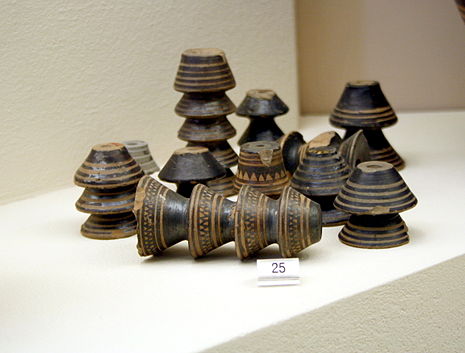
These whorls all fit together concentrically, resulting in a concave shape similar to a shield, graphically represented in a figure made by Newsome. The edge of each whorl is characterized by color and luminous quality (e.g. the edge of Mars is reddish) and each spins on the common axis mundi (pillar of light) in a direction contrary to the daily rotation of the fixed stars. Each edge has a particular width.
In the myth of Er is not clear why Plato has chosen this relative arrangement of the dimensions of the whorls: in a notoriously cryptic passage of the Timaeus we find a similar circular arrangement for the cosmos derived from the “proportions of musical harmony“.
The description of this harmony in the Timaeus is taken from the mathematical-musical philosophy of his contemporary Archytas of Taranto, Pythagorean of the 4th century BC. Among other things, Archytas had developed theories of sound in the function of movement and of different varieties of musical scales derived from particular relationships. He, therefore, conceived musical intervals of fifths (3: 2), quarters (4: 3), octaves (2: 1), tones (9: 8) and semitones (256: 243).
Archytas had not only used the particular ratios of a monochord, 4:3:2:1, and its interrelationships, but he had fixed the arithmetic and harmonic averages between the intervals of 2n where n is an integer or zero (i.e. 2 0, 2 1, 2 2, 2 3,… = 1, 2, 4, 8,…) and the intervals between 3 n (i.e. 1, 3, 9, 27,… etc.).
These harmonic relations constitute a mathematical manifestation emerging from natural phenomena and are exactly used as such by Plato in the Timaeus,, although it is not entirely obvious how these intervals physically manifested themselves.
Below is a table summarizing the qualities and dimensions of whorl whorls (our adaptation from Newsome):
| Smaller or wider whorl | 1st(8th) | 2nd(7th) | 3rd(6th) | 4th(5th) | 5th(4th) | 6th(3rd) | 7th(2nd) | 8th(1st) |
| Ball | moon | Sun | Venus | Mercury | Mars | Jupiter | Saturn | Fixed stars |
| Relative size of each whorl | 4th | 5th | 2nd | 6th | 3rd | 7th | 8th Smallest | 1st biggest |
| Color of each whorl | Reflected by the sun | More brilliant | 2nd brightest | yellowish | Pale red | Whiter | yellowish | multicolored |
| Rotation speed opposite to that of fixed stars | Faster | rapid | rapid | rapid | average | slow | Slower | Daily rotation (of Necessity) |
Below is the graphical representation of the above-mentioned mathematical relationships, again taken from Newsome.
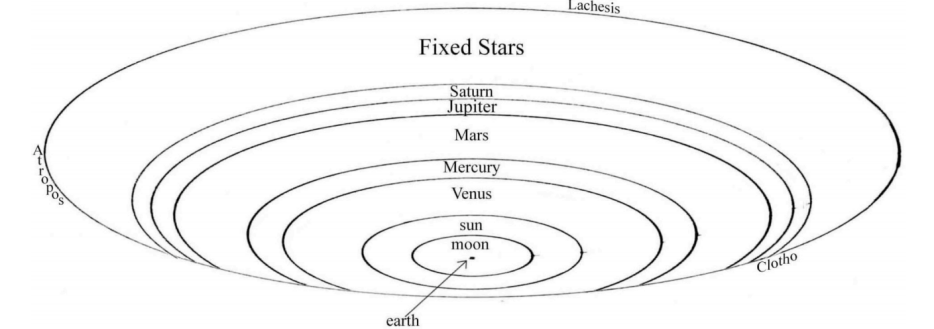
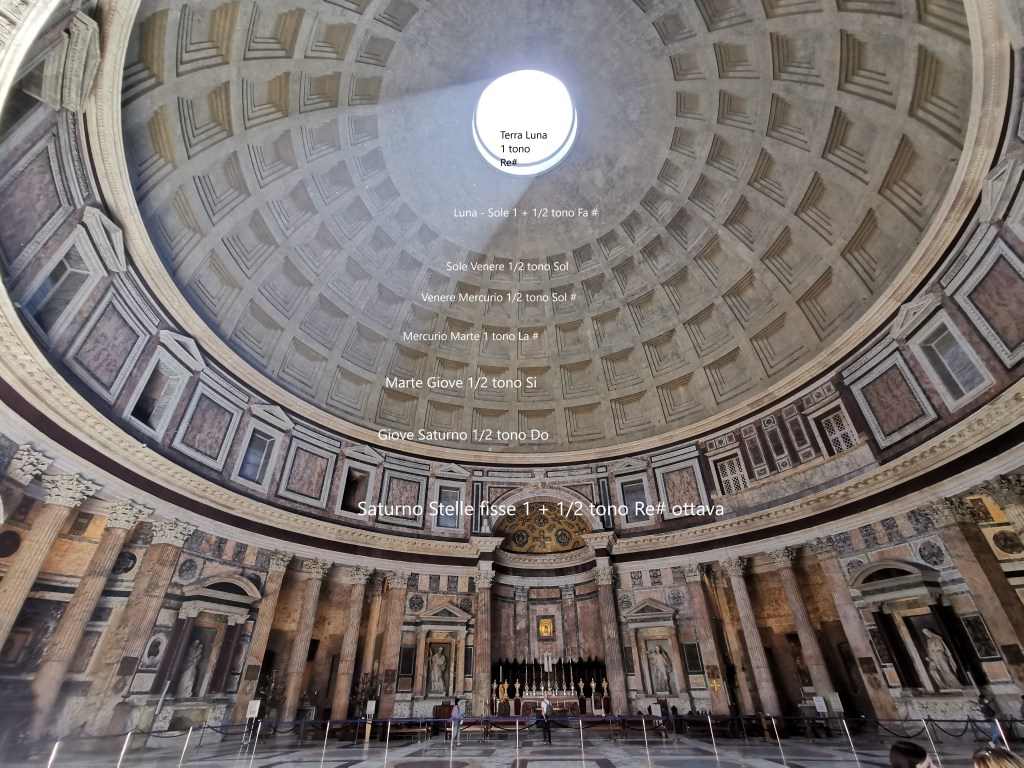
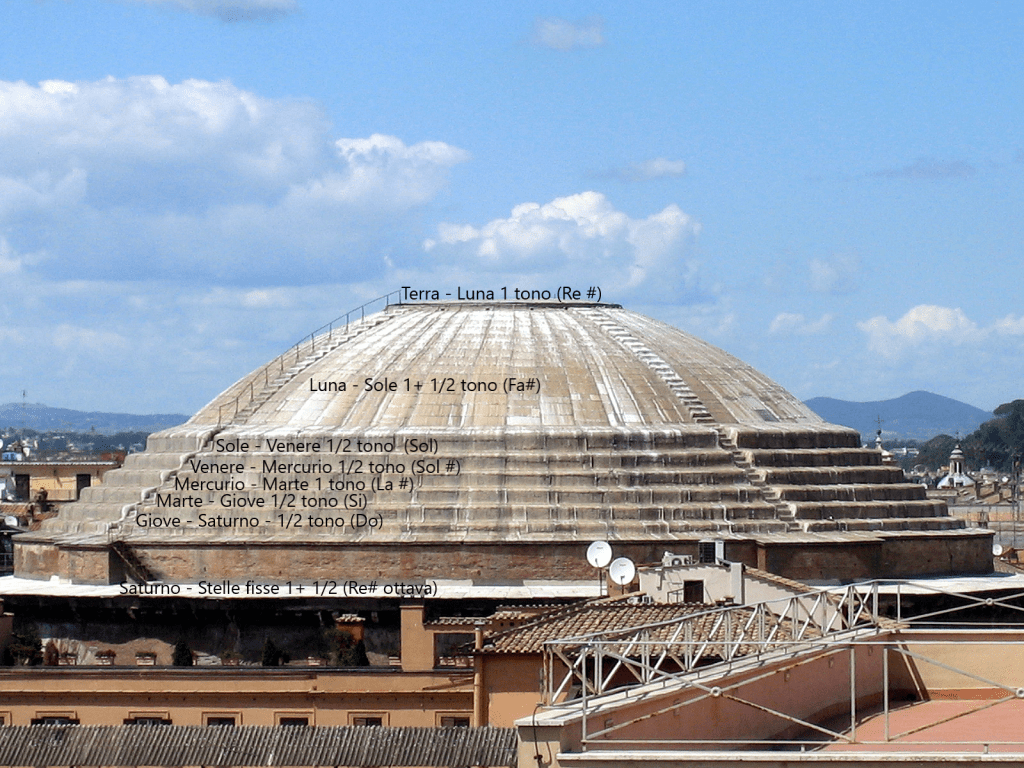
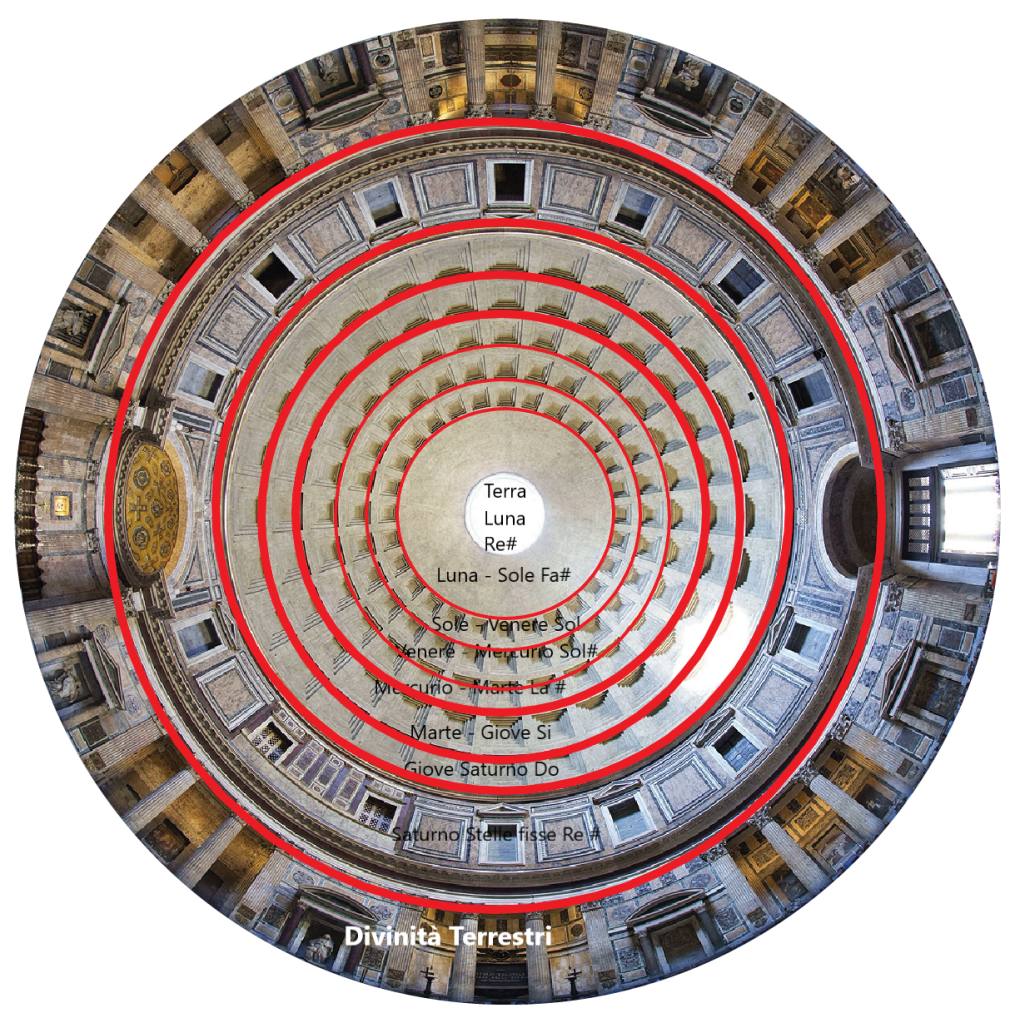
As we will see later, this shield-shaped representation of the whorls reproduces the upturned dome of the Pantheon with surprising accuracy.
Let us now hear how Plato exposes, in the Timaeus, the relationship between the different astral movements:
After each of the celestial bodies, which are necessary for the formation of time, arrived in the orbit that was most suitable for it, their bodies, connected by animate bonds, became living beings and learned their task, then according to the movement of the other which is oblique and passes through its movement and is controlled by it, some traveled a greater orbit, the others a smaller orbit and those who traveled a smaller orbit were faster, those who traveled a greater orbit were slower. Thanks to the movement of the same, the celestial bodies that revolved more rapidly seemed to be reached by those that revolved more slowly, even if they reached them: in fact, this movement turned all their orbits into a spiral and moving one in one direction and the other in the opposite direction, made that planet that moved away the slowest from this movement, which is the fastest, seem the closest.
The numbers of the Timaeus have a significance that goes beyond their mathematical meaning; mathematics is employed analogically to express an intrinsic kinship between metaphysical principles and
their effects of beauty and order in reality.
Accordingly, a musical scale made of harmonious numbers (ratios= logoi) makes possible the symbolic contemplation (symbolike theoria) of the paradigms in their effects or images.
The Platonic-Pythagorean conception of mousikè corresponds to a broad notion of music that encompasses the harmonious order of everything in the universe.
For the Pythagoreans, the derivation of number and the mediation of music produced the whole cosmos, as Aristotle says
they [the Pythagoreans] saw that the modifications and the ratios of the musical scales were expressible in numbers; since, then, all other things seemed in their whole nature to be modelled on numbers, and numbers seemed to be the first things in the whole of nature, they supposed the elements of numbers to be the elements of all things, and the whole heaven to be a musical scale (harmonia) and a number. And all the properties of numbers and scales which they could show to agree with the attributes and parts and the whole arrangement of the heavens, they collected and fitted into their scheme.
There are echoes of this Pythagorean conception in Plato’s account of the origin of the order of the heavenly circuits and their dependence on harmonic circles and musical intervals within a World-Soul composed as a musical scale. According to the Timaeus the universe is a kosmos (beautifully arranged whole), as the result of a combination of harmonia (a harmonious fitting together/attunement, from the verb harmottein) and taxis (order and regularity).
But let us return to the illustration of the Platonic whorls.
Plato writes in the myth of Er that “On each of those circles, at the top, a Siren moved, emitting a single note of a single tone; but from all eight only one harmony resounded”. The Sirens weren’t the only ones singing. Seated on equidistant thrones, along the edges, were the three Moirae, “the daughters of Necessity” (as seen in the illustration in the Newsome). Lachesis sang the past, Clotho the present, and Atropos the future.
They were also responsible for regulating the whorl rotations.
“Clotho with his right hand touched at intervals the outer circle of the whorl (that of the fixed stars) and helped it to turn.”
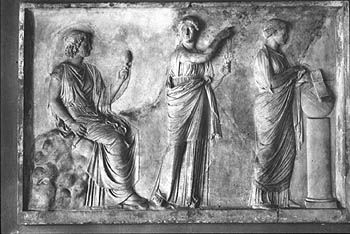
Clotho was therefore responsible for maintaining the daily rotation of the heavens. Atropos, on the other hand, touched the inner circles, those of the planetary spheres, with his left hand, or in the opposite direction to the revolution of the fixed stars.
Lachesis accompanied both movements now with one now with the other hand.
Clotho was the Moira who sings the present. With her right hand, adjust the speed of rotation of the outermost sfere as if she was spinning a roulette wheel. In other words, she regulates the daily, fixed rhythm which forms the basis of all the mechanical and immutable movement of the heavens, that of the Circle of the Same.
It is within this larger sphere that the other spheres are carried. The Sun, the Moon, and the planets have their own motions, but their principal motions are determined in relation to the sphere of the fixed stars, whose motion constitutes the most evident of all cycles.
Atropos, with her left hand, is instead responsible for regulating the rotations of the internal spheres.
“In other words, she maintained the speed of the seven spheres with different radial trajectories, thrown against the movement of the external roulette wheel.”
Atropos is the Moira who sings about the future. It is from the knowledge of the movements of the internal spheres, in fact, that it is possible to draw predictions and forecasts. In particular, the knowledge of the seasonal (“wise”) cycles of the Sun and the Moon is of utmost importance for agriculture, activity, and human affairs.
In the Timaeus we read that day and night “Represent the period of the unique and wiser circular movement: the month was born instead when the Moon reaches the Sun after having traveled its orbit, and the year when the Sun has traveled its orbit.”
It is more difficult to try to understand the role of Lachesis, who sings the past and alternately controls the inside and outside of the spheres with both hands, right and left, allowing the acceleration and deceleration of the stars.
We think that Plato was referring to the least predictable motions in the heavens: that is, to the retrograde motions, those of the Circle of the Different, of which we spoke earlier, and to the variations in the apparent speed of the planets.
He writes in the Timaeus :
As for the periods of the other planets, since men do not know them, except for a few, they have not even been named and their mutual relations are not measured in numbers by observation, so that, so to speak, men do not know that time is also measured by their revolutions, infinitely multiple and extraordinarily varied: nevertheless it is possible to understand that the perfect number of time realizes the perfect year when the velocities of all eight periods, completing each other, return to the point starting point, measured according to “The orbit of the Same” which moves uniformly.
Newsome argues that since the planets (literally, planetes or “wanderers”) had such intricate motions, related to retrograde motions and the like, they were not useful for predictions into the future.
So long as “their mutual relationships are not measured” (between planets and between planets and the Sun and Moon), this would have precluded prediction of where and when a planet would be found in relation to the foreseeable times and places of the Sun and Moon.
Thus, the author suspects that they were more likely to have been useful for locating events in the past. Hence their association with Lachesis. Newsome gives an example: “Mars may have been in Libra when an earthquake hit Athens many years ago .”
We believe more likely to believe that the “song of the past” of Lachesis is to be referred to the planets precisely because of their retrograde motion. This motion constitutes, in fact, a “tear” in the “space-time continuum” of the immutable stellar rotation. Going back (towards the past), the retrograde motion of the planets interrupts the regularity of the cyclical courses.
The fact that Lachesis used both hands, allowing accelerations, decelerations, and backward returns, cannot fail to bring to mind what has been said about labyrinthine lustrationes: purification ceremonies based on forward and backward motions (with musical antistrophe, see ahead), could be a ritual image of the supernal gestures of Lachesis.
Having said the symbolic gestural aspect, let us return to the musical theme. Also because the time has come for a conceptual clarification. If Lachesis with her movement determines a return to the past which coincides with the retrograde motion of some planets, as stated above, this contrary motion (called by Macrobius, we will soon see it, antistrophe) cannot fail to determine a change of direction musical. That is, the musical scale, in our opinion, from ascending, as in the ascent of Philology (we will talk about it shortly), should, in the opposite direction, i.e. in antistrophe, be transformed from ascending into descending.
On an imaginary spindle whorl or pyramid, if you like, the upward movement of the heavens would be developed with ascending notes, the downward movement from the heavens with descending notes.
If you consider the cosmos described in the Timaeus it is possible that the tones sung by each Siren were determined by the above Pythagorean harmonic rays.
In this regard, an (imperfect) attempt to reconstruct the Platonic model of the musical cosmos was that made by Stephenson on the basis of the distance (rays) from the Earth, described below.
| Sphere | Earth | Moon | Sun | Venus | Mercury | Mars | Jupiter | Saturn | Fixed stars |
| Radii measured from the center of the earth | none | 1 | 2 | 3 | 4 | 8 | 9 | 27 | ? |
| Ranges reconstructed for the previous planet | silence | 1(1:0) | 1:2 | 2:3 | 3.4 | 4.8(1:2) | 8:9 | 9:27 (1:3) | 27? |
| Musical intervals from low to high | none | Unison?Tone? | octave | fifth | fourth | octave | tone | Octave + fifth | ? |
Another possibility is that the tones were correlated with the orbital speeds as mentioned by Cicero in the Sleep of Scipio.
In the following paragraphs, we will see other more convincing reconstructions of cosmic harmony.
We would like to close by going back to Plato in Timaeus :
And harmony, endowed with similar movements to circles of our soul, to those who intelligently use the Muses it does not seem useful, as is now believed, to procure unreasonable pleasure: but it was given by the Muses to order and make consonant with itself the circle of our soul that was become discordant.
THE COSMIC MUSIC OF MACROBIUS
Through the philosopher Macrobius, although he was born more than three centuries after Augustus (about 385 – about 430), we can trace an overall fresco of Neoplatonic thought.
He was a scholar of astronomy and, like almost everyone at the time, followed the geocentric theory, which places the Earth, stationary, in a central position with respect to the Universe.
He wrote a commentary in two books of Cicero’s Somnium Scipionis, dedicated to his son Eustazio.
Macrobius’ goal is to show how all of the ancient thought, and above all the Neo-Platonist doctrines are contained in the Ciceronian text. He holds that God, origin of all that exists, creates Mind (nous), and that Mind creates the Soul of the World; the Soul of the World, incorporeal, “looking back”, gradually degenerates until it becomes the matrix of bodies.
In his Commentary, Macrobius dwells on the theme of the mathematical relationships that preside over harmony.
We read some passages of Book II, in our translation, where he specifically deals with the music of the spheres. It’s a subject of rare value for the information contained. Let’s start with an excerpt from chapter I.
Now it is well known that in the heavens nothing happens by chance or chance and that all the things above proceed in order according to the divine law. Therefore, it is indisputably fair to assume that harmonious sounds come from the rotation of the celestial spheres since the sound must come from movement, and the reason, which is present in the divine, is responsible for the sounds being melodious
Pythagoras was the first of all Greeks to grasp this truth. He understood that the sounds coming out of the spheres were regulated by the divine Reason, which is always present in Heaven, but he had difficulty in determining the underlying cause and finding ways to discover it. When he was tired of his lengthy investigation of a problem so fundamental yet so hidden, a chance event presented him with what his deep thought had overlooked.
From here on, Macrobius tells of the well-known legend of the discovery of harmony made by Pythagoras in a blacksmith’s workshop. He then moves on to dealing with harmonic combinations.
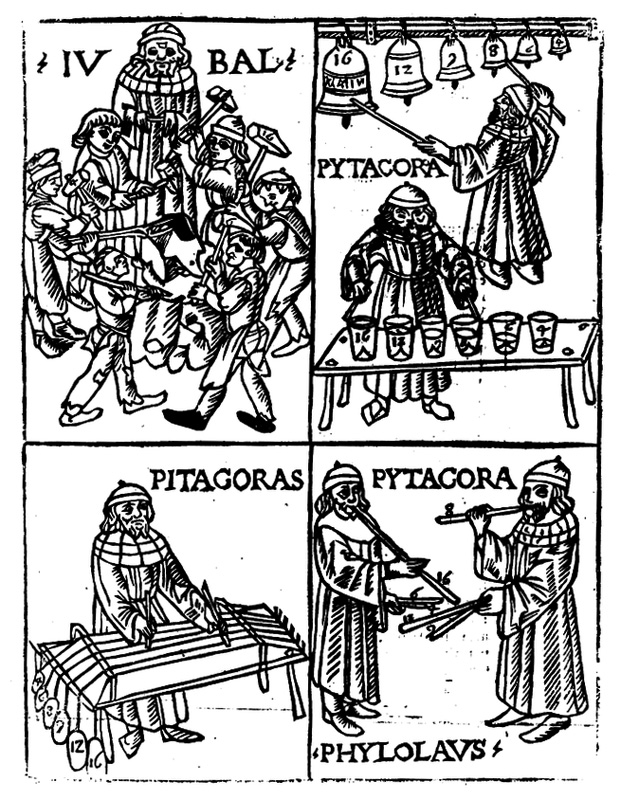
Presenting the subject a certain obscurity, we must, for reasons of synthesis, refer to the mathematical explanation of these relationships in the text cited in the note. We continue to chapter II.
So the Soul Mundi, which moved the body of the universe to the movement we now see, must be intertwined with those numbers that produce musical harmony to harmonize the sounds it instilled by its life-giving impulse. He discovered the source of these sounds in the fabric of his own composition.
Plato reports, as we have said before, that the divine Creator of the Soul, after having woven it of unequal numbers, filled the intervals between them with sesquialters, sesquitertians, superoctaves, and semitones. In the next passage, Cicero very skillfully shows the depth of Plato ‘s doctrine: “What is this great and pleasant sound that fills my ears?” “This is a concord of tones separated by unequal but yet carefully proportioned intervals, caused by the rapid movement of the spheres themselves.” You see here how he mentions intervals and claims that they are unequal and that they are separated in proportion; since in Plato’s Timaeus the intervals of unequal numbers are interspersed with numbers proportional to them, that is, sesquialters, sesquitertians, super octaves and half tones, in which every harmony is embraced. So we clearly see that these words of Cicero would never have been intelligible had we not included a discussion of the sesquialters, sesquitertians and superoctaves inserted into the intervals, and of the numbers with which Plato constructed the Soul of the World, together with why the Soul it was interwoven with numbers that produced harmony. In so doing we have not only explained the revolutions in the heavens, for which the Soul alone is responsible; we have also shown that the resulting sounds must have been harmonious because they were innate in the Soul which propelled the universe into motion.
We continue with the third chapter of the second book.
In a discussion in the Republic of the whirling motion of the celestial spheres, Plato says that a Siren sits on each of the spheres, thus indicating that by the motions of the spheres the deities were provided with song; for a singing Siren is equivalent to a god in the Greek acceptance of the word. “Furthermore, cosmogonists have chosen to regard the nine Muses as the harmonious song of the eight spheres and the only predominant harmony that comes from all of them.” Furthermore, they call Apollo, god of the Sun , the “leader of the Muses”, as if to say that he is the leader and the leader of the other spheres, just as Cicero, referring to the Sun, called him leader, leader, and regulator of the other planets, mind, and moderator of the universe. Even the Etruscans recognize that the Muses are the song of the universe, as their name is Camenae, a form of Canenae, derived from the verb canere. That priests recognize that the heavens sing is indicated by their use of music in sacrificial ceremonies, as some nations prefer the lyre or lyre, and some flutes or other musical instruments. Even in the hymns to the gods the verses of the verse and the antistrophe were set to music so that the verse represented the forward motion of the celestial sphere and the antistrophe the reverse motion of the planetary spheres; these two movements produced the first hymn of nature in honor of the Supreme God. Even in funeral processions, the customs of different peoples have decreed the use of musical accompaniment, due to the belief that souls after death return to the source of sweet music, that is, to Heaven. Every soul in this world is enticed by musical sounds so that not only those who are more refined in their habits, but also all the barbarian peoples, have adopted songs from which they are inflamed with courage or courted with pleasure; for the soul carries with it in the body a memory of the music it knew in Heaven, and is so fascinated by its charm that there is no breast so cruel or savage as not to be seized by the spell of such a plea. (…) We have just explained that the causes of harmony are traced back to Soul Mundi, having been entwined in it; the Soul Mundi, moreover, provides all creatures with life: “Hence the race of man and animals, the life of winged things and the strange shapes that the ocean carries under its glass floor”. Consequently, it is natural that everything that breathes is enraptured by the music since the celestial Soul that animates the universe has sprung from the music. In accelerating the spheres to movement it produces tones separated by unequal intervals but nevertheless carefully proportioned according to its primordial fabric.
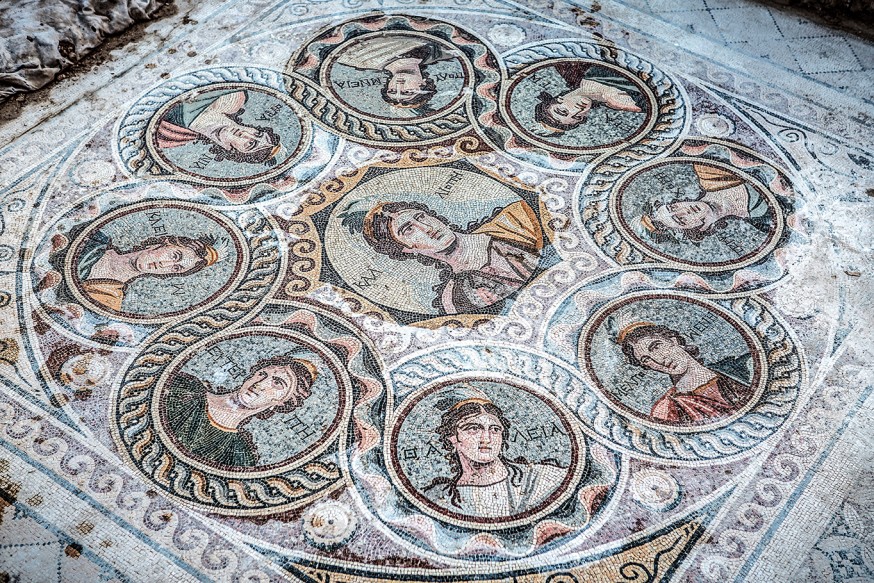
Macrobius in the passage reported here mentions a strophe and an antistrophe. The assumption of the Platonic philosopher was that the verse represented the forward motion of the celestial sphere while the antistrophe represented the inverse motion of the planetary spheres.
Given that, to put it like Hermes, what is in Heaven is like what is on Earth, according to us, the verse movement would represent the upward motion towards the stars, while the reverse motion of the antistrophe would represent the downward motion.
That is, if you want to ascend to the stars, to “apotheosize” yourself, you need to use musical verses with notes in an ascending scale, while to ask for the descent of the divine power from above onto the Earth, you need notes in a descending scale.
Now we must ask ourselves if these intervals, which in the incorporeal Soul are learned only in the mind and not by the senses, govern the distances between the planets hovering in the corporeal universe. Archimedes, in fact, believed that he had calculated in stages the distances between the earth’s surface and the Moon, between the Moon and Mercury, Mercury and Venus, Venus and the Sun, the Sun and Mars, Mars and Jupiter, Jupiter and Saturn, and that he had also estimated the distance from Saturn’s orbit to the celestial sphere. But the figures of Archimedes were rejected by the Platonists for not respecting the intervals in the progressions of the numbers two and three. They decided that there could only be one opinion, that the distance from the Earth to the Sun was twice that from the Earth to the Moon, that the distance from the Earth to Venus was three times greater than that from the Earth to the Sun, that the distance from Earth to Mercury was four times greater than from Earth to Venus, that the distance from Earth to Mars was nine times greater than the distance from Earth to Mercury, that the distance from Earth to Jupiter was eight times greater than that from Earth to Mars, and that the distance from Earth to Saturn was twenty-seven times greater than that from Earth to Jupiter. Porphyry includes this belief of the Platonists in his books that illuminated the darkness of the Timaeus, and says that they believed that the intervals in the bodily universe, which were filled with sesquiterzians, sesquialters, superoctaves, midtones and a leimma, followed the pattern of the fabric of the body. Soul and the harmony was such that its proportional intervals were woven into the fabric of the Soul and that they were also injected into the bodily universe which is vivified by the Soul. “Hence Cicero’s claim that celestial harmony is a concordance of tones separated by unequal intervals but nevertheless carefully proportioned, it is in all respects wise a and true.
With the aforementioned theses, Macrobius will have, we suppose, participated in some complex erudite dispute on the theme of the Platonicity of the contents of Cicero ‘s Somnium.
Certainly, he could not have imagined that centuries later he would have provided us “dressed monkeys” with smartphones as well , some arguments for the interpretation of the function of the Pantheon.
ASCENT BY MEANS OF THE HARMONY OF THE SPHERES AND OF THE MUSES
For Homer the Muses are nine, they are daughters of Zeus and are on Olympus. In the prologue of his Teogonia Hesiod also speaks of nine Muses, “enriching Heaven and the stars with divinity.”
Regarding the denomination of “Muse”, Proclus said that, since philosophy, platonically “great music,” makes our psychic powers move harmoniously with respect to entities and their movements, we enter into an agreement with the universe as we make our soul cycles similar to those of the universe, this is why that we derive from this research the name we give to the Muses. And goes on:
[…] And in truth we know that the Muses are those who inculcate the search for truth in souls, the multiplicity of powers in bodies, everywhere the truth of harmonies.
Therefore, the Muses are Goddesses of the spheres, a role originally attributed to the Sirens, then assigned to the Muses, who appear to be superior to them. In fact, Proclus said that the division of Heaven was into eight spheres, that of the whole World into nine spheres and that the first division, in Plato’s Republic, had been dedicated to the Sirens, while the second to the whole set of Muses, under which are the Sirens.
In one of the speeches attributed by Iamblichus to Pythagoras, the Muses were appointed to watch over universal harmony. They were not, however, identified with each of the planetary spheres. Pythagoras had suggested building a temple to the Muses to maintain harmony in the city because these Goddesses, he said, all bore the same name together, were known to tradition as a community and delighted in the highest degree in common worship, and then the chorus of the Muses was always one and constantly the same, and in addition, it contained chord, harmony, and rhythm, that is, everything that creates concord. Finally, it showed how their power extended not only to the highest scientific principles but also to the harmony and harmony of the universe.
With regard to the Muses, Macrobius writes in the Commentary:
Even the theologians have understood with the nine Muses the melodious accents of the eight celestial spheres with the supreme single chord that results from the whole. This is why Hesiod, in his Teogonia, gives the eighth muse the name of Urania: because after the seven wandering spheres, which are placed under it, the octave, the star sphere that is above them, is Heaven properly said; and to make us understand that there is a ninth, greater than all, which results from the union of all the harmonies together, he adds: Calliope: this is excellent among all, meaning with this name that the ninth Muse is designated by sweetness same as the voice. Calliope, in fact, means in Greek “endowed with a beautiful voice”, and to expressly indicate that it is a harmonious whole resulting from all the others, the poet assigns it an expression that indicates universality: it is excellent above all.
And Proclus, on the same theme:
the Ancients gave the superintendency over the Universe to the Muses and Apollo Musagete, the one who provides for the unification of the overall harmony; the others keeping together the divided progression of this harmony, their number having accorded with that of the eight sirens of the Republic. The Muses and Apollo Musagete were, in fact, created by the Demiurge, “as well as the chain of Hermes. In him therefore there are above all demiurgic calculation and harmony, since one belongs to Hermes, the other to Apollo, and, when filled with both, the soul participates in both calculation and harmony.
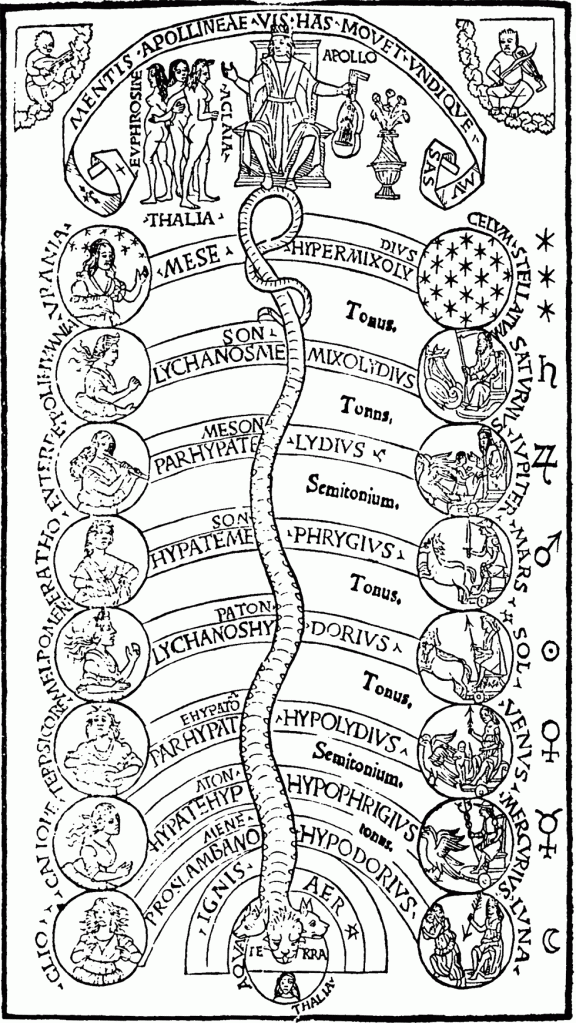
In the following period Marsilio Ficino referred to Martianus Capella‘s Le nozze di Filologia e Mercurio when, in dealing with the harmony of the spheres, he says that Urania occupies the outermost sphere of the starry Firmament, which rotates quickly, echoing with a high-pitched sound, Polyhymnia regulates the sphere of Saturn, Euterpe that of Jupiter, Erato controls the sphere of Mars, Melpomene the median sphere, where the Sun embellishes the universe with flaming light, Terpsichore joins the gold of Venus, Calliope embraces the circle of Cillenium, that is Mercury, Clio places his residence in the nearest sphere, namely the Moon, which resounds with low notes, with rougher musical modes; Thalia, on the other hand, is abandoned on Earth, devoid of sound. This representation coincides with that of Gaffurius where, next to Apollo, the three Graces are depicted, and under the Muses in the aforementioned planetary order.
ASCENT BY MEANS OF VOCALIZATIONS
A God or divine man “called Thoth in Egypt, distinguished the vowels” writes Plato in Philebus.
In Greek, as in Sanskrit, there are seven vowels; in Latin and Italian five, however, they rise to seven if the vowels “o” and “e” are each counted twice, one for the open sound and the other for the closed sound. The Egyptians had a Song of the seven vowels.
Since the seven vowels were used in place of the seven tones of the seven-stringed lyre (tuned on the joint tetrachord of the Doric scale), according to the Pythagoreans the letters can be read as notes. According to the Pythagorean doctrine, in fact, each tone of the scale represented the note of one of the seven planets. Each vowel, therefore, represents a kind of magical symbol of the music of the spheres. The indication to determine the tuning fork of each of the tones symbolized by a vowel was found in the Harmony of Nicomachus of Gerasa, which from the Pythagoreans took up precisely the harmonic conception of the world. In fact, he writes in his Harmonica Manual: “The sounds of each of the seven spheres produce a certain noise, in which the first sphere produces the first sound, and these sounds have been given the name of vowels.”
He further specifies:
All those who have used the seven-tone symphony as natural borrowed it from this source: not from the spheres but from the sounds tuned into the universe, the only sounds that we call, among letters, vowel-sounds and musical sounds. But since the analysis of these points is of an elementary simplicity, which cannot suffice to explain complex questions, it is necessary to understand the conception of the Universe from the affinity, analogous to that of the strings, and through the accommodation of one thing to another.
John the Lydian assimilated the seven stars to the seven species of octave and to the seven vowels of the Greek alphabet.
The concordance of vowels, planets, tones was made even by the Gnostics. According to Irenaeus, the Gnostic Mark “The Magician” wrote: “The first Heaven plays the A, the following the E, the third the long E, the fourth in the middle shouts loudly the Power (dynamis) of the I, the fifth the O, the sixth the U, the seventh and fourth starting from the middle evoke the element of Omega.”
Here is Marcus’s system, as proposed by Lindsay:
| A | moon | Nete | D sharp |
| E | Venus | Paranete | C sharp |
| H / È | Mercury | Paramese | B flat |
| I | Sun | Month | A |
| O | Mars | Lichanos | G |
| U | Jupiter | Parhypate | F |
| Ω / Ò | Saturn | Hypate | E |
Assuming an invocation to the planetary gods sung on the seven vowels in the temples of ancient Egypt, before Lindsay, Edmond Bailly wrote that: each of the seven Greek vowels corresponded to one of the seven bodies of the planetary system of the Ancients, expressing at the same time one of the seven notes of the lyre of Hermes. The scheme is a triple septenary of stars, notes and vowels, in which: “the vowels have their radical vocalism, without taking into account the changes in accent caused by times and places”:
| A | Moon | D |
| E | Venus | C |
| H / È | Mercury | B |
| I | Sun | A |
| O | Mars | G |
| U | Jupiter | F |
| Ω / Ò | Saturn | E |
Boella and Galli correctly observe that “the descending system described coincides with the cosmic and planetary scale, but not with the ascending musical scale, referred to in the title page of Gaffurius’ Practica musice of 1496 (see in the images).
However, they do not draw the consequences, i.e. they do not impute the inversion as an error.
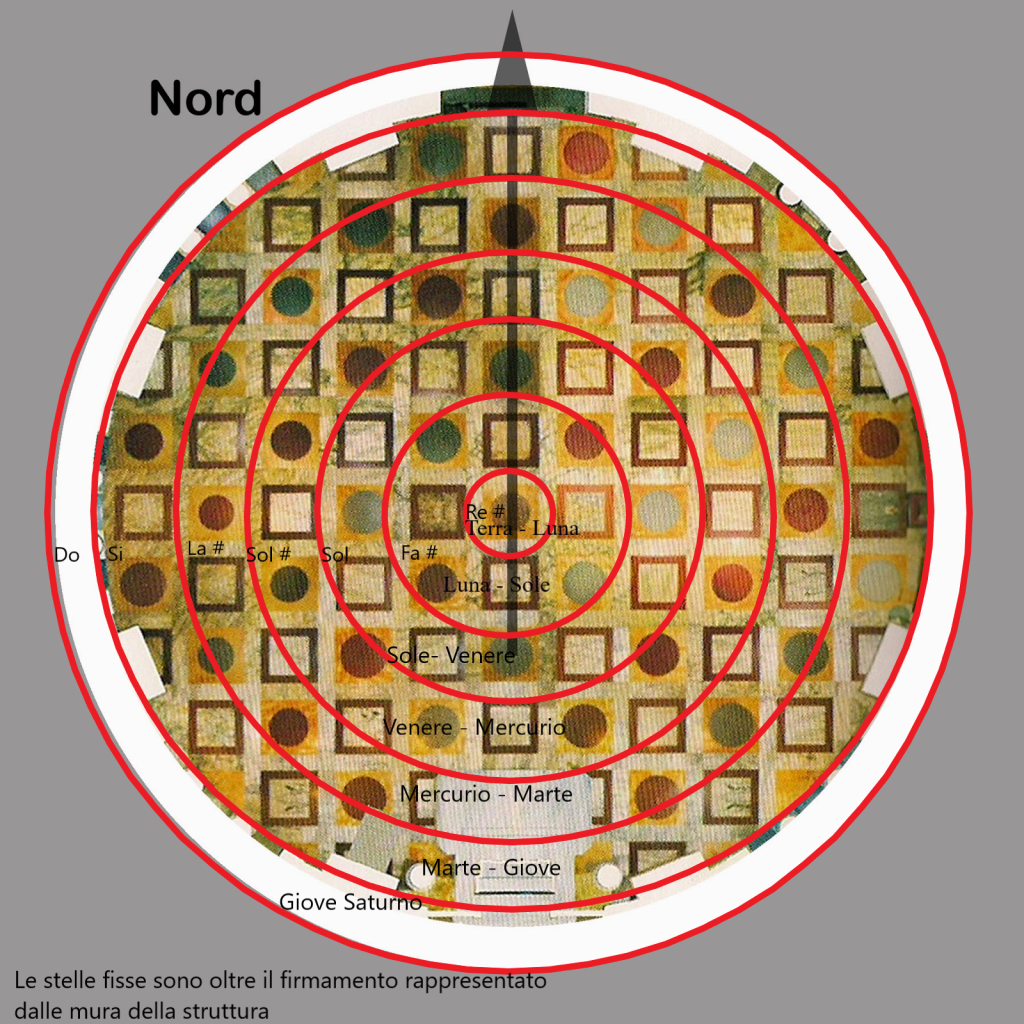
Let’s examine the two schemes divided into vowels, stars, chordii and notes. We believe that both Bailly (although he was a musicologist) and Lindsay have made some confusion and mistakes. Reporting Marco’s scheme, cited by Irenaeus, they correctly reported the ascending vowel sequence (from the Moon to Saturn), but they made a mistake in associating it with the sequence of strings and notes which, instead, they indicated as descending. They also erred in associating relationships with the stars.
Going back to the strings, we note that those first mentioned in the diagram were the highest. The Greek names for the strings of the seven- and eight-string lyres saw the first note as higher and closer to the player. The strings were as follows: Nete, Paranete, Paramese; Mese, Lichanos, Parhypate, Hypate (this is the scheme proposed by Lindsay); or Nete, Paranete, Trite, Paramese; Mese, Lichanos, Parhypate, Hypate – the last four from Mese to Hypate being the finger tetrachord, the others being played with the plectrum.
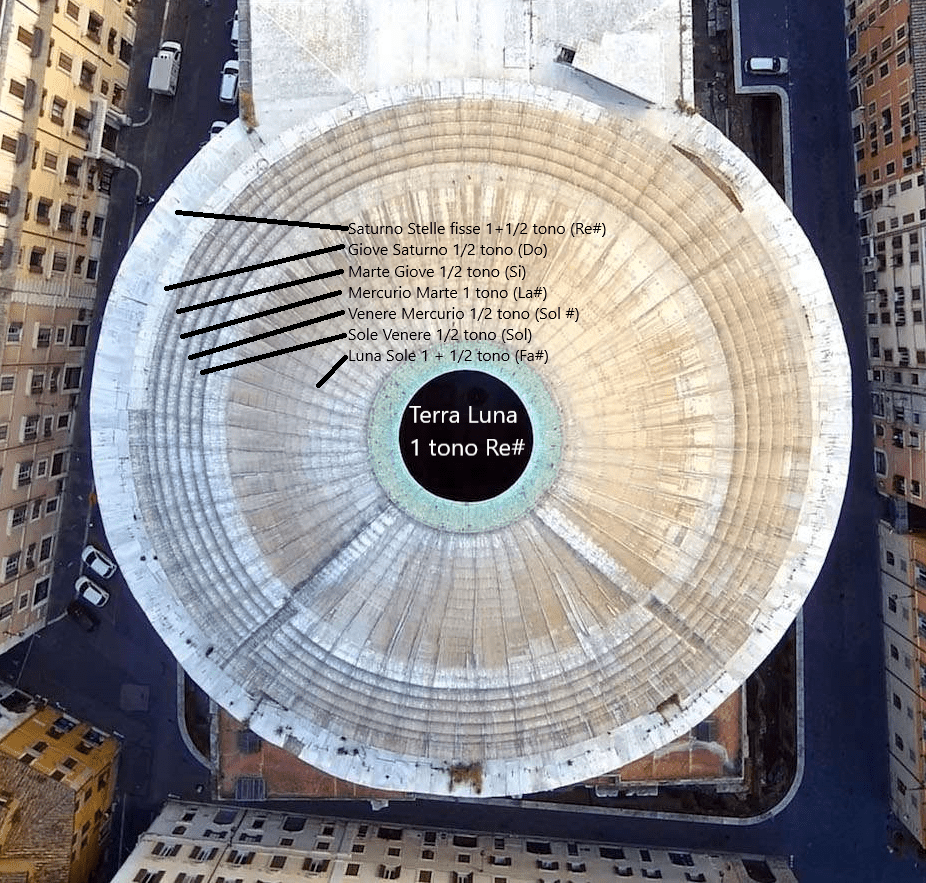
The ascending pattern of the strings of the Pythagorean musician Gaffurius is still different, as shown in the illustrations, where, of the previous pattern, only the strings Lichanos, Parhypate, Hypate are shown corresponding to the asters Sun, Venus and Mercury, in an (ascensional) direction or contrary to the one followed by the Lindsay (which is descendant).
If you follow the correct sequence, where Nete is the highest note and the others progressively lower, the result is that the order is reversed. That is, the correct order should be.
| A | moon | Hypate |
| E | Venus | Parhypate |
| H / È | Mercury | Lichanos |
| I | Sun | Mese |
| O | Mars | Paramese |
| U | Jupiter | Paranete |
| Ω / Ò | Saturn | Nete |
Correspondingly the musical notes indicated by Bailly and Lindsay should also be reversed. Problem: We see inconsistencies and errors. To name one, the note of Saturn would be an E which is not an octave of D sharp (and in any case the octave should be in the fixed stars!).
It is necessary to make a brief digression in order to understand the correct sequences of planets, strings and notes, or rather stellar harmony. Let’s start with a “Pythagorean” memory of Pliny.
Pliny deals with the theme of the harmony of the spheres inserted in the broader treatment of the question of astral distances.
Many have also attempted to trace the intervals of the stars from the earth, and have shown that the sun is nineteen parts as distant from the moon as the moon itself is from the earth. But Pythagoras, a man of sagacious, sagacious mind, deduced that from the Earth to the Moon there were 126,000 stadia, from the Moon to the Sun twice as far from it, and then tripled up to the twelve signs (zodiac), of the same opinion was also Sulpicius Gallus.
But Pythagoras sometimes appeals to music also for the distance of the Moon from the Earth, from the Moon to Mercury half a space, as from Mercury to Venus, from Venus to the Sun six times, from the Sun to Mars a tone [i.e. how much from the Earth to the Moon ], from Mars to Jupiter a semitone as also from Jupiter to Saturn, and therefore six times up to the zodiac; Thus are made the seven tones which they call διὰ πασῶν ἁρμονίαν Διὸς, this is the concert of the universe. In it Saturn was moved to the Dorian mode, Jupiter to the Phrygian tone, and so on all the others, with a subtlety that is pleasant rather than necessary.
Let us listen to Pizzani: “To the affirmation that Pythagoras would have fixed the distance from the earth to the moon at 126,000 stadiums – a figure which, doubled and tripled, would provide us, according to an opinion also shared by Sulpicius Galo, with the exact determination of the distances between the Moon and the Sun and between the Sun and the sphere of the fixed stars— followed by a real series of notes, also attributed to Pythagoras, in which the distances between the eight celestial spheres of the ancient tradition (including the Earth) are translated into as many intervals musical.
The sum of these intervals, amounting to seven tones, would correspond, according to Pliny, to what the ancients called diapason harmonia, or octave interval (which, in reality, included only six tones!).”
Tannery had observed that this is the oldest evidence of the legend according to which Pythagoras would have foreseen the distance between the Earth and the Moon and would have, at the same time, translated the astral distances into musical intervals.
As far as it matters for the purposes of this essay, the aforementioned Pliny scale is almost identical in Censorinoand in Martianus Capella. These two authors both set the distance of the Moon from the Earth at 126,000 stadia.
Only Pliny and Martianus Capella affirm that the sound emitted by each celestial body is a definite mode.
While Censorino and Martianus Capella identify tout court the figure of 126,000 stadia with the first tone of the Pythagorean range, Pliny does not agree. He expresses himself in the sense that the philosopher of Samos would have proposed two completely different criteria to define the distances between the stars, without confusing or assimilating them to each other. This distinction would be confirmed by Pliny’s subsequent affirmation that, according to an opinion also shared by Sulpicius Galo, by doubling and tripling the initial figure one would obtain, respectively, the distance between the Moon and the Sun and between the Sun and the sphere of the fixed stars . The Pythagorean scale assumed, on the contrary, that the distance between the Moon and the Sun corresponds to two and a half times (as visible this scale is not the Platonic one where the Sun is immediately after the Moon) and that between the Sun and the fixed stars three and a half times the distance between the Earth and the Moon.
Pizzani derives the hypothesis that
“Pliny drew his data from two distinct sources. Varro would have provided him with the musical scheme of astral harmony and the figure of 126,000 stadiums with the explicit attribution of these doctrines to Pythagoras; on the other hand, from a work by Sulpicius Galo, a work explicitly mentioned by Pliny himself a little further back, further indications about the way to calculate the distances of the sun and the fixed stars would derive.
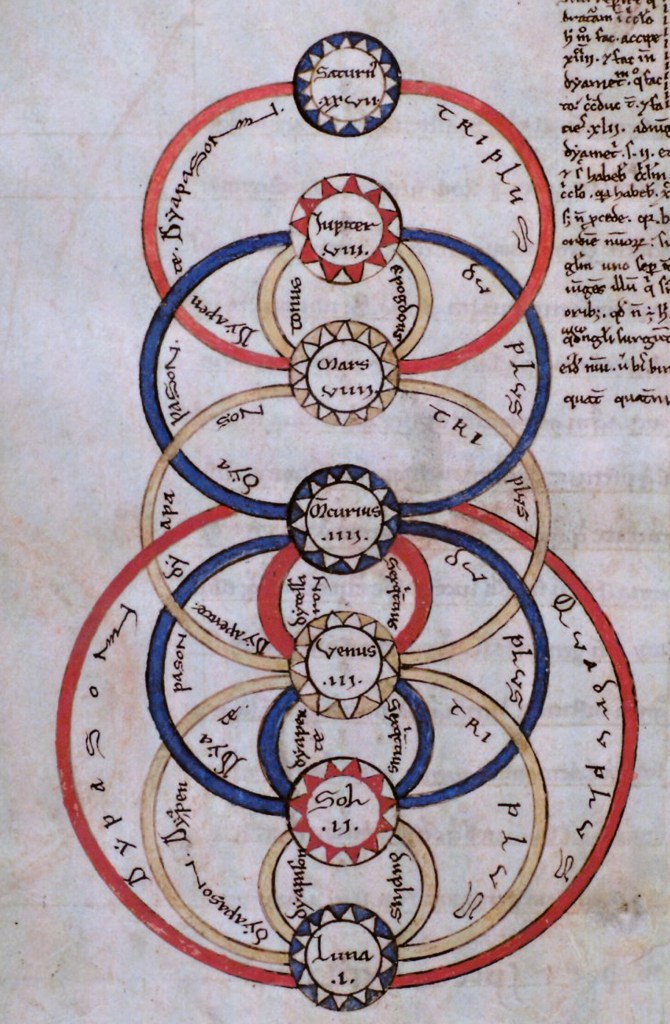
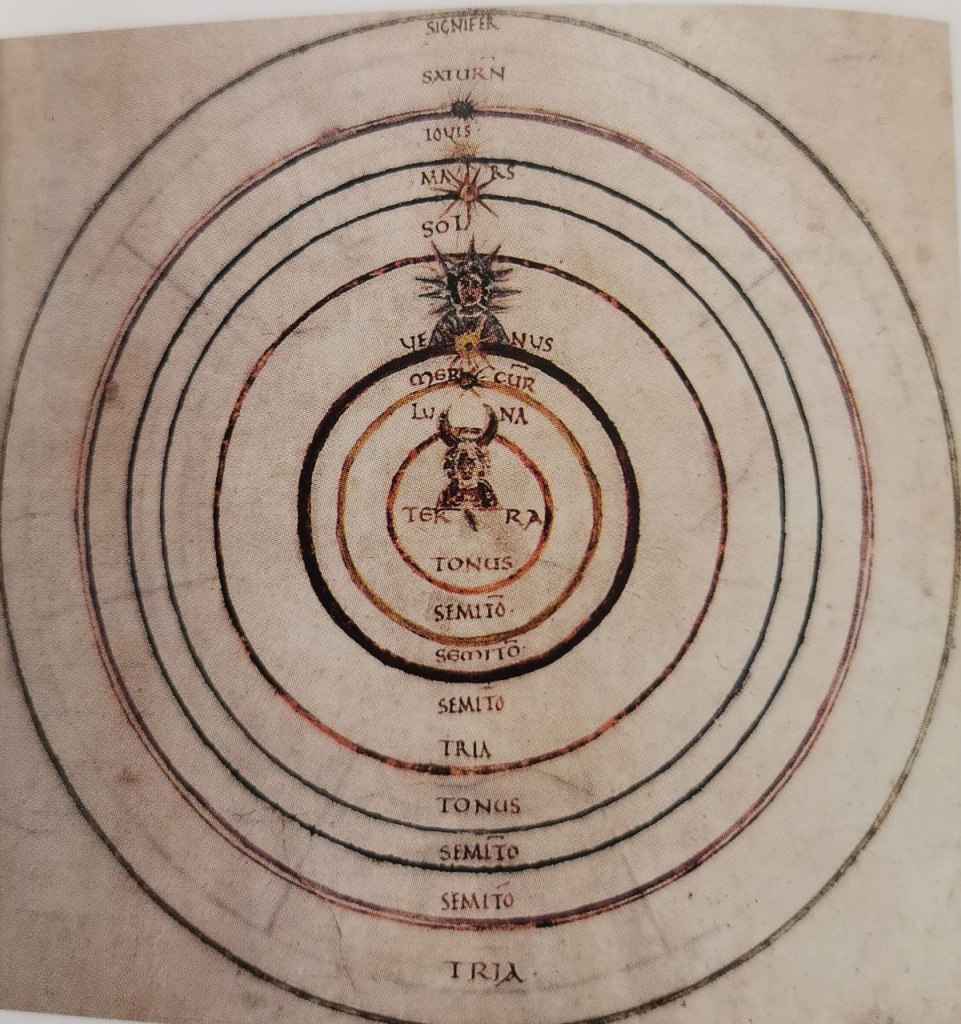
In order to find, therefore, the right sequence in the relationships between the notes, we need, in our opinion, to refer to Pliny, to Martianus Capella’s Nozze di Filologiavii and Mercury and to an extraordinary document such as the one contained in the collection of Astronomical Manuscripts of 820 AD. circa, preserved in Salzburg.
If we refer to these documents we may be able to correct the sequence of notes and the relationship between them.
| – | Earth | silence | silence |
| A | Moon | Hypate | D sharp |
| E | Venus | Parhypate | E |
| H / È | Mercury | Lichanos | F |
| I | Sun | Mese | A flat |
| O | Mars | Paramese | B flat |
| U | Jupiter | Paranete | B |
| Ω / Ò | Saturn | Nete octave | C |
| A | Moon | Hypate | D sharp octave |
The sequence of ratios for the musical ascent would thus be divided into a tone between the Earth and the Moon, a semitone between the Moon and Venus, a semitone between Venus and Mercury, three semitones between Mercury and the Sun, a tone between the Sun and Mars, a semitone between Mars and Jupiter, another semitone between Jupiter and Saturn and three semitones to get to the fixed stars.
Finally, let us compare the superior scheme we have revised with that of Stephenson, already examined, with that of the rise of Philology and with that of the concentric astral spheres (seen from above) portrayed in the image above. By comparing the relative ratios between them, we obtain the following synoptic scheme of the ratios calculated in semitones:
| Aster | Our scheme | Stephenson | SalzburgCollection | Martianus Capella / Favonius Eulogius /Plinius | Censorinus |
| Earth- Moon | 1 | 1 | 1 | 1 | 1 |
| Moon -Venus | 1/2 | 1/2 | 1/2 | 1/2 | 1/2 |
| Venus-Mercury | 1/2 | 2/3 | 1/2 | 1/2 | 1/2 |
| Mercury-Sun | 1 + 1/2 | 3/4 | 1 + 1/2 | 1 + 1/2 | 1 + 1/2 |
| Sun-Mars | 1 | 4/8 (1/2) | 1 | 1/2 | 1/2 |
| Mars-Jupiter | 1/2 | 8/9 | 1/2 | 1/2 | 1/2 |
| Jupiter-Saturn | 1/2 | 9/27 (1/3) | 1/2 | 1/2 | 1/2 |
| Saturn-Fixed Stars | 1+1/2 | 27 | 1+1/2 | 1+1/2 | 1/2 |
We observe that there is a close correspondence between the sequence of Pliny, Martianus Capella and that of Salzburg. The only difference is that, in the relationship between the Sun and Mars, Capella speaks of a semitone, while the Salzburg manuscript speaks of a tone. We lean towards the “Salzburg” hypothesis since we must not forget that the great belt of asteroids/planetoids insists between the Sun and Mars.
For the rest, the correspondence between Pliny, Capella and Salzburg is total.
Having said this, let’s go back to the vocal theme.
It is doubtful that the note-vowels were really sung. Lindsay says that Nicomachus seemed to consider some kind of mystical murmuring, as he claimed that initiates invoke the god by making hissing, inarticulate and incoherent sounds. The vowels were present so that the initiate could transfer the sound from an earthly sphere to a celestial one; the earthly notes had to be transformed into the music of the spheres.
Silence, Sige, was then considered “the first companion of the divine name,” as we will see shortly.
The Leyden Papyrus reports some examples of vocalized invocation:
I call upon you, Lord, with a hymn sung; I celebrate your holy power AEHIOYΩΩΩ and the even more important one: “Your name is composed of seven letters, according to the agreement of the seven sounds that have intonations corresponding to the 28 lights of the Moon.
Also noteworthy is the cosmic hermetic prayer to the supreme God (Aiòn):
(…) To you belongs the eternal party hall where your name, the heptagram, stands like a sacred image, according to the harmony of the seven vowels whose sounds correspond to the twenty-eight houses of the Moon. From you come the good influences of the stars, demons, fortunes, and Destinies (…)
As can be seen in this prayer, the seven vowels have seven notes and correspond to the 28 houses of the Moon. Could it be a coincidence that the lacunaries of the dome of the Pantheon are 28 in number for each of the five rows?
In another hermetic magic recipe, the “Kosmopoiia of Leiden” reads:
Lord, I reproduce your image with the seven vowels, come to me and listen to me: a éé êêê iiii ooooo uuuuuu ôôôôôôô
Also in the last cited papyrus, “Kosmopoiia di Leiden“, we find a further vocalization enriched by references to nine Gods and the seven planets:
And after taking the apexes of their names from the nine Gods with their power, he was called Bosbeadii, and when he had done the same for the seven planets, he was called Aeeiouo, Eeiouo, Eiouo, louo, Ouo, Uo, O, Ouoieea, Uoieea, Oieea, Ieea, Eea, Ea, A (powerful and admirable anagram). As for its greatest name, it is this great and holy name, of 27 letters (PM, at the end Iao); in another form: PM, then Iao ou aeeiouo. So when the god comes, lower your eyes, etc.
From the Ritual of the Great Magical Papyrus of Paris we draw the following exceptional passage:
(…) I invoke the immortal venerable your living Names, those who never descended into mortal nature, who never yet articulated themselves in the language of man, in voice or in mortal language!
ÈEÒ. OÈÈÒ. I OR. OÈ. ÈEÒ. ÈEÒ. OÈEÒ IÒÒ. OÈÈE. OÈÈ. ÒOÈ. IÈ. ISÒ. OÒ. OÈ. IEÒ OÈ. ÒOÈ. IEÒOÈ. IEEÒ. EÈ IÒ. IT IS IT IS. ÒIsÒ. EOÈ. OEÒ. ÒIÈ ÒIÈE Ò. OI. III. ÈOÈ. ÒEÙ. ISÒ. OÈE. EÒÈIA AÈAEÈA ÈEEÈ. EEÈ. EEÈ. IEÒ ÈEÒ OÈEEOÈ ÈEÒ EYÒ. OÈ. EIÒ EÒ OÈ. ÒIs ÒIs EE. OOOYIOÈ
Of all this with fire and spirit from beginning to end, then a second time (and so on) until (you) have realized the seven immortal Gods of the cosmos.
Also in this excerpt of the ritual, the seven stars are connected to the seven vowels. In this regard, keep in mind the correspondence between H = È (H / È, note = yes, star = Venus) and Ω = Ò (Ω / Ò, note = mi, star = Saturn).
In the Trattato “De elocutione“, Demetrius Falereus (345 BC-282 BC ca.), wrote that the Egyptian priests sang in praise to the gods by means of the seven vowels,
pronounced in due order and then repeated, creating a sound as harmonious as that of the flute and the citara; likewise, the Persian magician Ostanes pronounced each divine name according to seven vowels, which have a direct relationship with the seven planets.
Demetrius praised the harmonic effect of a succession of vowels in a literary composition, citing Homeric forms such as èelios or oreion.
Strange names and vowel combinations play a considerable part in spells:
Your Name is composed of Seven Letters according to the Harmony of the Seven Tones which have their sound according to the Twenty-eight Lights of the Moon, Saraphara, Araphaira, Braamarapha, Abraach, Pertaomech, Akmech , Iao: ouee, iaõ, oue, eiou, aēë , e éou, eeou, lao . “I invoke you Lord in a hymn-shaped song, I celebrate your Sacred Might, ae é ioooo. Sacrifice after singing: é i ovo …
Demetrius also speaks of the 28 lunar houses (or lights), therefore.
Finally, Dio Cassius explained that the list of planets represented the order assigned to the seven days of the week.
In modern times, Seyffarth observed that it was known that the seven notes of the octave and the seven vowels corresponded to the seven planetary spheres, so much so that the seven notes of the planetary spheres were thought to be the seven vowels.
“The soul is physically forced to move”, wrote Aristides Quintilianus, where under the influence of instrumental music.
Just as, according to Pythagorean arithmetic, the soul is a harmony resulting from ratios of numbers, similarly, musical harmony is made up of similar ratios:
the very physical constitution of the soul includes the same elements of which musical instruments are also made up: there is a correspondence between the fibers of the soul and the strings of the lyre and the citara, between the breath of the soul and the air produced by the sound of wind instruments.
Also in the Myths of Hyginus we read that the Moirae or Fates would have invented some of the seven vowels.
The Pythagorean awareness of the harmonic scale of the astral spheres was therefore part of the spiritual culture of the time. This harmonic scale would have “physically forced the soul to move ” in harmony with the higher astral spheres with which it shared, remember, the life-giving substance of the ether.
We have therefore examined some of the theurgic techniques of the Roman era that may have been employed by the emperor Octavian to ascend to the stars, as announced by prodigies, wanted by the people, and finally decreed by the Senate.
The solar rays, the stones, the herbs, and, above all, the vocalizations, with the musical notes referring to the Muses and the planetary divinities, according to the sources of the time, were as many technical components used ritually for the preparatory purification for the ascent.
It remains to examine how the purification of the soul took place by means of the reproduction of the stellar movement on Earth, according to the hermetic principle quod est inferius est sicut quod est superius.
AURELIO BRUNO
(themes drawn from Aurelio Bruno, “The Pantheon of the Sky, 2022, ISBN: 979-8370654237)
Disclaimer
Last updated: February 26, 2023
Interpretation and Definitions
Interpretation
The words of which the initial letter is capitalized have meanings defined under the following conditions. The following definitions shall have the same meaning regardless of whether they appear in singular or in plural.
Definitions
For the purposes of this Disclaimer:
- Company (referred to as either “the Company”, “We”, “Us” or “Our” in this Disclaimer) refers to Il Pantheon del Cielo.
- Service refers to the Website.
- You means the individual accessing the Service, or the company, or other legal entity on behalf of which such individual is accessing or using the Service, as applicable.
- Website refers to Il Pantheon del Cielo, accessible from www.pantheondecoded.org
Disclaimer
The information contained on the Service is for general information purposes only.
The Company assumes no responsibility for errors or omissions in the contents of the Service.
In no event shall the Company be liable for any special, direct, indirect, consequential, or incidental damages or any damages whatsoever, whether in an action of contract, negligence or other tort, arising out of or in connection with the use of the Service or the contents of the Service. The Company reserves the right to make additions, deletions, or modifications to the contents on the Service at any time without prior notice. This Disclaimer has been created with the help of the TermsFeed Disclaimer Generator.
The Company does not warrant that the Service is free of viruses or other harmful components.
External Links Disclaimer
The Service may contain links to external websites that are not provided or maintained by or in any way affiliated with the Company.
Please note that the Company does not guarantee the accuracy, relevance, timeliness, or completeness of any information on these external websites.
Errors and Omissions Disclaimer
The information given by the Service is for general guidance on matters of interest only. Even if the Company takes every precaution to insure that the content of the Service is both current and accurate, errors can occur. Plus, given the changing nature of laws, rules and regulations, there may be delays, omissions or inaccuracies in the information contained on the Service.
The Company is not responsible for any errors or omissions, or for the results obtained from the use of this information.
Fair Use Disclaimer
The Company may use copyrighted material which has not always been specifically authorized by the copyright owner. The Company is making such material available for criticism, comment, news reporting, teaching, scholarship, or research.
The Company believes this constitutes a “fair use” of any such copyrighted material as provided for in section 107 of the United States Copyright law.
If You wish to use copyrighted material from the Service for your own purposes that go beyond fair use, You must obtain permission from the copyright owner.
Views Expressed Disclaimer
The Service may contain views and opinions which are those of the authors and do not necessarily reflect the official policy or position of any other author, agency, organization, employer or company, including the Company.
Comments published by users are their sole responsibility and the users will take full responsibility, liability and blame for any libel or litigation that results from something written in or as a direct result of something written in a comment. The Company is not liable for any comment published by users and reserves the right to delete any comment for any reason whatsoever.
No Responsibility Disclaimer
The information on the Service is provided with the understanding that the Company is not herein engaged in rendering legal, accounting, tax, or other professional advice and services. As such, it should not be used as a substitute for consultation with professional accounting, tax, legal or other competent advisers.
In no event shall the Company or its suppliers be liable for any special, incidental, indirect, or consequential damages whatsoever arising out of or in connection with your access or use or inability to access or use the Service.
“Use at Your Own Risk” Disclaimer
All information in the Service is provided “as is”, with no guarantee of completeness, accuracy, timeliness or of the results obtained from the use of this information, and without warranty of any kind, express or implied, including, but not limited to warranties of performance, merchantability and fitness for a particular purpose.
The Company will not be liable to You or anyone else for any decision made or action taken in reliance on the information given by the Service or for any consequential, special or similar damages, even if advised of the possibility of such damages.
Contact Us
If you have any questions about this Disclaimer, You can contact Us:
- By email: pantheondecoded@gmail.com
 Il Pantheon del Cielo