aureliobruno©2023
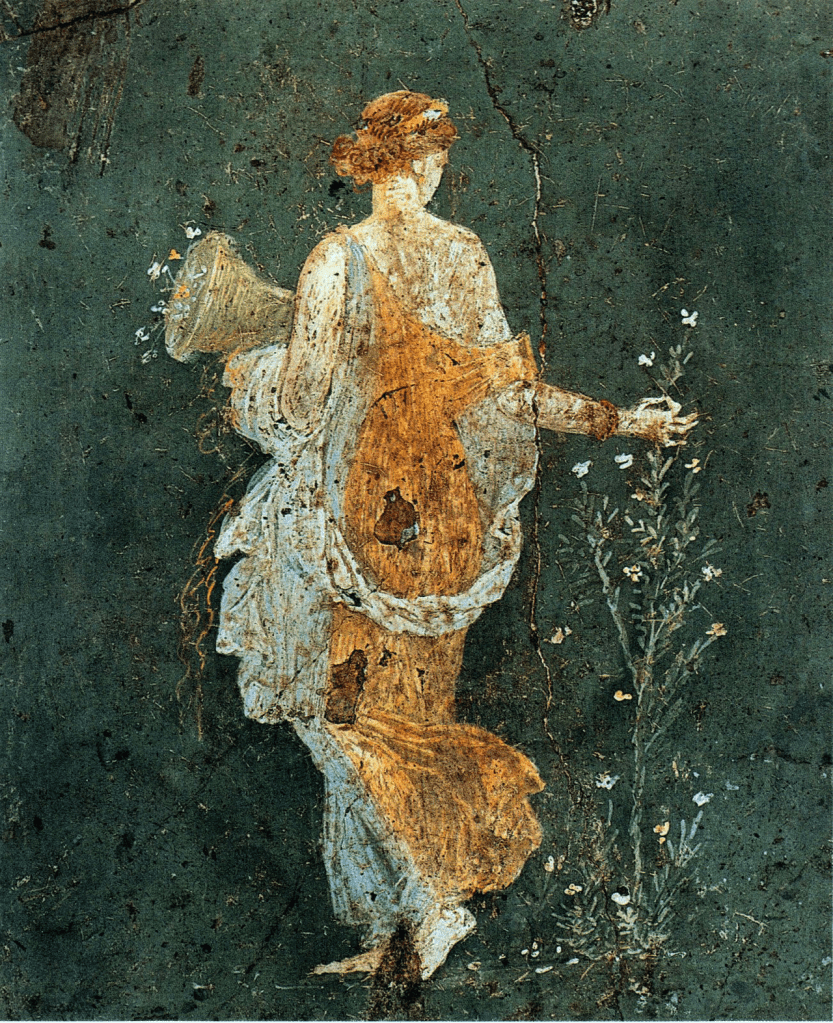
This is what happens to us too: relegated to some cavity of the Earth, we believe we live high up, on its summit, and we call it Heaven, the air, convinced as we are that it is the space where the stars turn.
(Plato, Phaedo)
And these are the affections of the world (kosmou), rotate and disappear. And rotation is upheaval, and disappearance is renovation. So, the intelligible world depends on God, that one sensible from the intelligible, and the Sun, through the intelligible and sensible world, dispenses the flow of Good from God, that is, action creator
(Hermes Trismegistus , Corpus)
Thus, they (the Pythagoreans) believe that the ratio of the velocities of the stars, in relation to the distances, are the same as those of the musical chords, and, therefore, they say that the sound of the rotating stars is harmonic
(Aristotle, De Caelo)
“(…) When, on the other hand, a man has tended with all his zeal to true knowledge and thoughts, and, of all his faculties, exercised mainly those of the spirit, such a man, is of absolute necessity, when he arrives at the truth, he has in his heart and in his thoughts the immortal and the divine and, to the extent that human nature is permitted to participate in immortality, in no way escapes him. It does not cease to worship the Divinity; he always cultivates, cared for, and arranged as he should, the “demon” who dwells in him: therefore he necessarily rejoices in a singular eudaemonia (…)
(Plato, Timaeus)
We have seen how, on the political level, the apotheosis of the emperor and reviewed the sources on the subject.
Now is the time to understand what were the conceptions of the world and of Heaven on which the idea of the apotheosis of a human being was based, even if an emperor, as well as what was the cultural context – rectius, mystical – which determined its emergence.
Let us, therefore, begin by examining the ideas that the people of the time had about the cosmos and the planet in which they lived.
MAN AND ASTERS
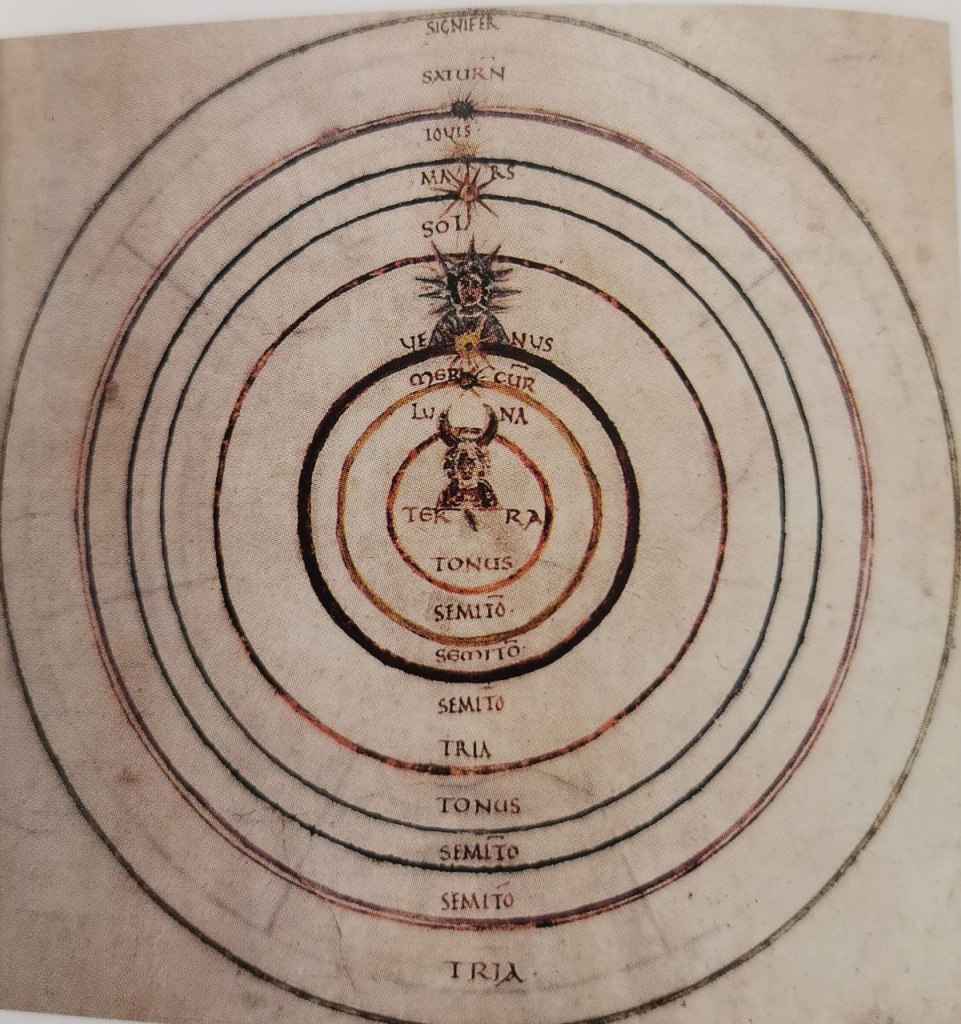
Before going into the ancient cosmos, it is necessary to make a premise: the “World” is not the Earth, as we understand it today, visible on the globe.
The World was the whole made up of the Earth, the waters, and the eight Heavens above it.
The starry sky revolved around the stationary Earth and not the other way around.
There was no “cosmos” outside the World. The Cosmos was the World itself.
For today’s science, the cosmos is infinite, a frightening abyss of nothing around the Earth.
The Earth is no longer the center of the World. It carries the insignificant lives of men, in an incomprehensible and hopeless universe.
So hopeless that, by way of eschatological consolation, someone has hypothesized the grotesque pantomime of billions of saving Christ crucifixions in billions of alien worlds.
The pre-Copernican system, on the other hand, placed man at the center of the Universe.
For the thrice great Hermes man, the hypostasis of God was the true center of the World.
And that man, the center of the World, acquired wisdom and eternal life by contemplating the stars.
The meaning and purpose of the sage’s life was the return to the stars.
Let’s hear what the divine Plato says about it :
“As for this kind of soul that is sovereign in us, here is what we need to think about it. God has given it to each of us as a divine Genius, this kind of soul that we declare that it dwells in the upper part of our body and raises us, above the earth, towards those parents we have in heaven” since we are one plant not terrestrial, but celestial. And this language is perfectly true. Indeed, it is up there, from where the soul, for the first time, originated, that Divinity has suspended our head, which is like our root, and thereby gave the body an upright posture. Then when a man has long surrendered himself to the lusts of the flesh or the pursuit of honors, and it is for these things that he gives himself the greatest pain, all his preferences have necessarily inclined towards the earth and, as far as it is possible to make himself mortal, he lacks nothing because he recovers completely, since he has always applied himself to nourishing the mortal part. He tended with all his zeal to science and to true thoughts, and, all his faculties, he has exercised principally those of the spirit, such a man, of absolute necessity, when he comes to the truth, has in his heart and in his thoughts the immortal and the divine and, insofar as it is permitted to human nature to participate in immortality, nowhere escapes him. It does not cease to worship the Divinity; always cultivates, is cared for, and arranged as it should, the “demon” that dwells in him: he therefore necessarily rejoices in a singular “eudaemonia“. Now, there is only one way to take care of a thing, whatever it is: it is to provide it, each time, the nourishment and movements that are convenient. Now the movements that have an affinity with the divine principle in us are the thoughts of the Whole and its revolutions. Each of us, following these celestial movements, rectifies, with the knowledge of the harmonies and revolutions of the Whole, the revolutions (of the intellectual soul) in our head, which were tasted at the moment of birth; which makes the subject contemplating similar to the object contemplated, in conformity with the original nature of this subject; and thus, having completed this likeness, he reaches the supreme end of the better life, which the gods have proposed to men, for the present duration and for the time to come.”
CONFORMATION OF THE EARTH
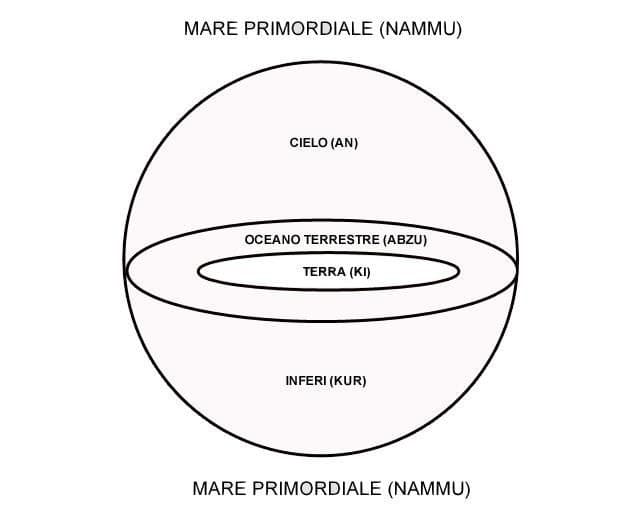
That the Earth was stationary was a concept accepted by everyone in the culture of the time.
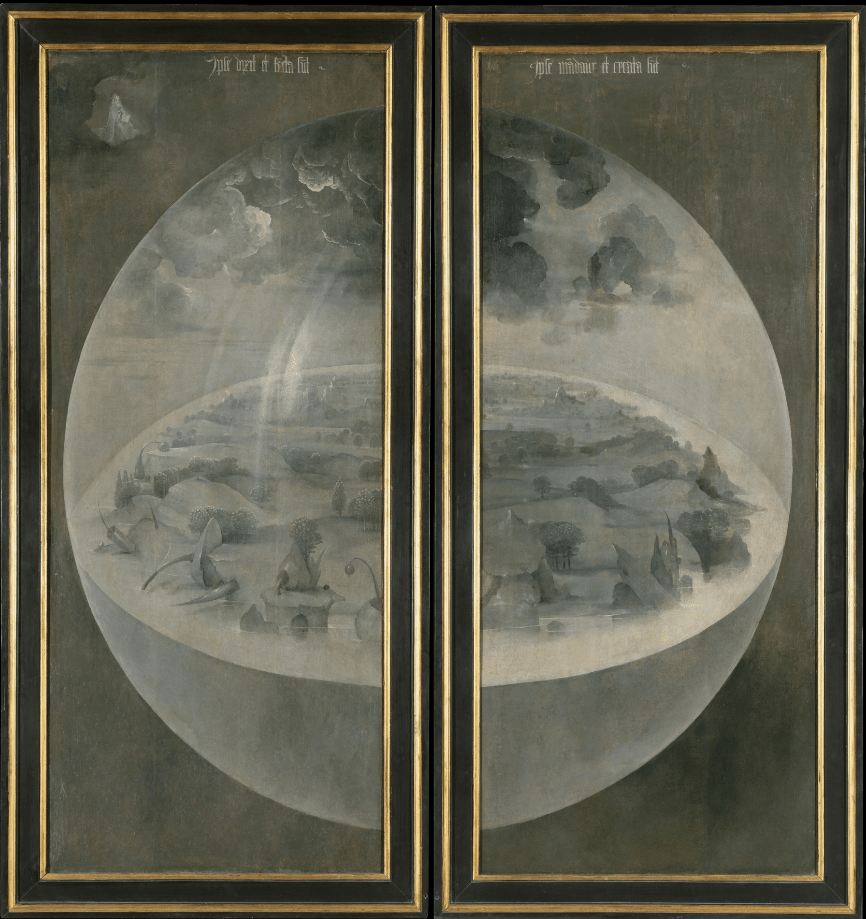
Most philosophers conceived the World as spherical, but with a different conformation compared to modern representations.
By “World” was meant not our globe, but a sphere in the middle of which, along the equator, was the Earth motionless and closed above by the Firmament in incessant rotational movement, and surrounded by waters.
Let’s see specifically, what were the conceptions of the various philosophers/scientists of the time.
Contrary to what some contemporary scholars claim, “Pythagoras was also the first to call the universe cosmos (World) and to say that the earth is convex in shape” (each plane is often a convex geometric figure). According to Theophrastus it was Parmenides, and according to Zeno, Hesiod.
Hermes, giving the floor to Isis, tells us about it: “… And Isis replied: – The Earth lies supine in the center of the whole, like a man who looks up to Heaven and is divided into as many parts as human limbs.”
Aristotle recounts how Thales said that the Earth floated inertly on water and remained motionless like wood on it.
Anaximander said that the Earth is hovering in the air, it is not supported by anything, and it remains suspended because it has equal distance from everything that surrounds it. It has a spherical curved shape, similar to a stone column or drum; one of its surfaces is the one on which we move, and the other is on the opposite side.
From Plutarchus we learn that he thought that the Earth had a cylindrical shape and that the height corresponded to one-third of the width.
Parmenides was the first to say that the Earth occupies the center of the universe.
He thought the Earth was convex in shape. Because it is distant from all points, it remains in equilibrium. Therefore, it only stirs, but it does not move.
Anaxagoras said that the Earth had a flat shape and that it remained to hover motionless by virtue of its size, “so much because there is no emptiness and because the air, which is very strong, supports the Earth resting on it . (…) The Earth is hollow and contains water in its cavities ”.
Even the Pythagorean Archelaus argued that the Earth was hollow, still and in the middle of everything and, as proof, he alleged that the Sun does not rise or set at the same time for all men, what it should do if the Earth was flat.
Again according to Anaxagoras, the reason for the stability of the Earth is its flat shape because it does not cut the underlying air but seals it like a lid, as we can see that flat-shaped bodies do, which are hardly shaken by the winds due to their resistance they oppose. The Earth would do the same thing in front of the underlying air due to its flatness and the air, not having sufficient space to move, would remain stationary below, all collected, like the water in hourglasses: “If the Earth had no shape flat could not stand still.”
In contrast, Diogenes of Apollonia said the Earth was spherical, firmly placed in the center, having achieved its constitution by virtue of circular motion due to heat and freezing due to cold.
Like Anaximander, Leucippus also maintained that the Earth had the shape of a drum.
Eratosthenes argued, according to Macrobius, that “the size of the Sun is 27 times larger than that of the Earth, while Posidonius said it would be many times larger than the Earth.
Let us now turn to Plato. We note that, due to the completeness and systemic coherence of his thought, we will be forced to quote various passages several times in reference to the various topics.
(…) I believe that the Earth is very large. (…) . This is what happens to us too: we reside in some cavity of the Earth, we believe we live high up, on its summit, and we call Heaven, the air, convinced as we are that it is the space where the stars turn; Here, my friend, what is said, that first of all this real Earth, to those who look at it from above, appears as one of those multicolored leather spheres, divided into twelve segments, of different colors, similar these, just, to those that painters usually use down here. And that Earth up there, all of these colors is painted, but much brighter and purer than ours: now, in fact, it is purple, of marvelous beauty, now it is gold or all white, whiter than chalk and snow, and the other colors, then, of which it is composed, much more numerous and more beautiful than we have ever seen. And the very cavities of the Earth, filled with lanes of water and air, take on a particular color in the variegated range of the other colors so that the Earth appears in its own iridescent and uniform hue.
A peculiar feature of the Platonic system of thought is that our Earth lies on a small cavity of a “real Earth”, very large, placed motionless in the center of the universe.
From Strabo, we learn that “Posidonius reports that the one who first divided the Earth into five zones was Parmenides, but that he declared the torrid zone almost double in extension (compared to that which is in the tropics), extending beyond the two tropics towards the outside and towards the temperate zones.”
Aetius tells us that for Parmenides the air is a “secretion of the Earth, which evaporates due to the pressure stronger than this”.
Xenophanes declared that the Earth was infinite and that it was not enveloped in every part of the air. He also said that all things came from Earth.
Lucretius expressed the same concept when he said that the Earth “remains stationary in the middle of the world”, that is, stationary in the middle of the world.
Democritus argued that the Earth was oblong, having a length equal to one and a half times the width and that, moreover, being mixed with water, where it was strongly compressed, “because of this, it became hollow and deep, while where it was little or no water allowed the mountains to appear.”
The astronomer of Rhodes, Geminus , criticized the theory of Crathes of Mallo which – about Odyssey 1, 23-24 – claimed that, according to Homer, the Earth was round. Rather, for Homer, as for all ancient poets, the Earth is a flat disk surrounded by the ocean. Geminus argued thus:
What Homer presents (about the Ethiopians) agrees entirely with the conception of the world we have reported (scil. The flat disc Earth), on the other hand, this no longer agrees with the real shape of the universe, which is that of a sphere. In fact, the Earth is located in the middle of the whole world, and with respect to this world, it appears only as a point.
Then Geminus keep on
The Earth in its totality has the value of a central point with respect to the sphere of the fixed stars, and it is impossible for any emanation or effluvium to penetrate from the fixed stars to the Earth.
About the size of the Earth, the astronomer Cleomedes believed that it was only a point in relation to Heaven and “Well it has been shown, with the arguments (…) that the Earth is immense in size, many reasons show that it is only a point, not only with respect to the total size of the universe but also in relation to the elevation of the Sun and which in any case is much smaller than the sphere that embraces the fixed stars (…)”
Metrodorus of Chios affirmed that “nobody that is in its proper place moves if there is no one who pushes it out (…) For that reason not even the Earth moves “.
An overall geographical definition of the Earth will be given by the astronomer Iginus:
The Earth, placed in the middle point of the world, equidistant from all its points, occupies the center of the sphere. The axis divides it into two parts along its entire length. The ocean, diffused in the peripheral part of the sphere, bathes the borders of the almost entire globe; “it is therefore believed that the constellations fall into it when they set.
The Earth was, in ancient thought, at the center of everything, as Plotinus also confirms: “therefore it will be better to listen to Plato, who says that there must be a solid in the universe that is thus resistant so that the Earth is placed in the center like a bridge, a solid base for those who walk on it ”.
Finally, also for the neoplatonic Macrobius, the Earth is stationary, immobile at the center of the Universe and, as explained, placed flat at the equatorial center of the world and not curved and following the circumference of the sphere, as accepted today.
THE IMPORTANCE OF PITAGORISM FOR UNDERSTANDING THE ANCIENT “WORLD”
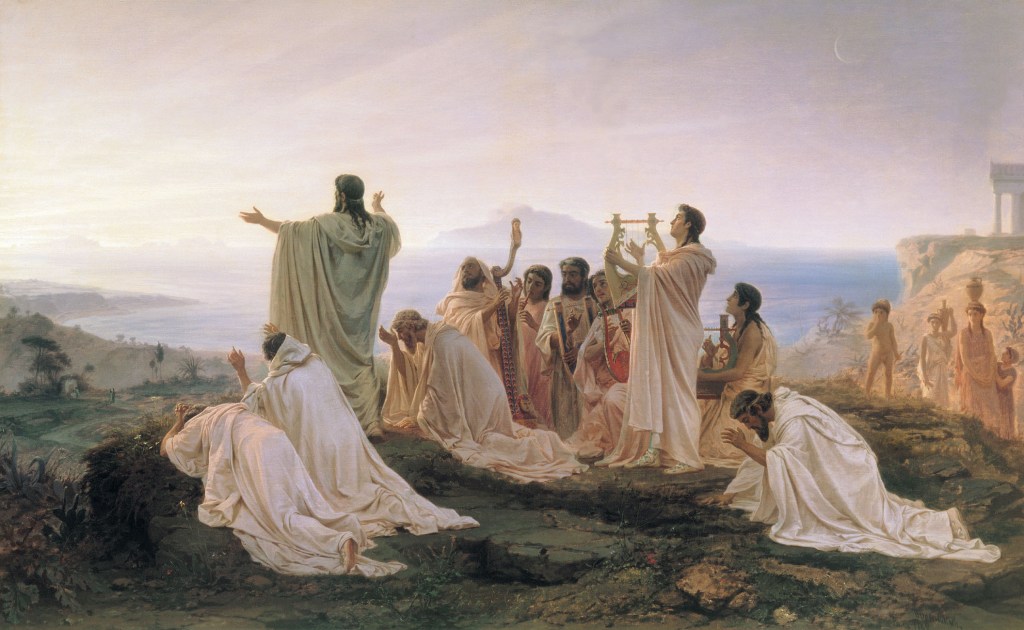
Today, Plato is rightly considered the main author on the subject of sidereal religion. However, the very strong influence exerted by Pythagoreanism on Plato and on all future doctrinal evolution on the subject emerges from the analysis of contemporary texts.
We will not go into the ancient and vexata quaestio on the quantity and quality of the arguments stolen by the divine Plato from the Archaegete Pythagoras. Nor will we concern ourselves with the famous book given by the Pythagorean Archytas to Plato.
Later we will talk about theories of Neopythagoreans (or Neoplatonists) such as Plotinus, Porphyry, Iamblichus, Proclus. We will analyze Pythagorean constructions on universal harmony as a way of purification from earthly impurities. We will enter a coherent world of thought expressed over the centuries by philosophers, astronomers, musicians, etc., all faithful to the same school, the Pythagorean one.
It was not done on purpose or for calculation of any kind.
All classical thought on the subject of the World and Heaven relentlessly always returns to the same Pythagorean foundations.
Let us leave one of the few contemporary scholars to illustrate the importance assumed by Pythagoreanism on all ancient astronomy.
Rougier correctly attributes to the great Pythagoras the great merit of having subverted the theories of the so-called “meteorologists”. They had expelled the divine from the cosmic nature, reduced to stones, pumice, fires, etc. The philosopher of Samos with the consideration of the intelligence of the motion of the Stars and of the planets themselves (by no means wandering in the way in which the “meteorologists” intended) had assimilated to their movement and to their etheric essence that of human souls. Hence, the Pythagorean astral religion and the return of transcendence in the study of nature and the cosmos, impregnated, as Hermes said, with soul. This conception was subsequently irremediably altered, first by the Copernican revolution, then by current scientism.
We hear from Rougier’s words:
As soon as the science of nature was born on the shores of Ionia, it entered into violent conflict with popular religion, as evidenced by the trial for atheism brought against Anaxagoras of Clazomenes, the prop.ator in Athens of the physics of the Milesians, in the century of Pericles. Astrophysicists, then called meteorologists, argued that the erratic movements of the planets were the result of Fortune and chance and, equating the genesis of stars with the formation of meteors, professed the “terrestrial nature” of stars and the material unity of the world. These atheistic consequences drove many minds away from the study of this science, most notably Socrates and the young Plato in his wake. Socrates professed the need to limit the study of astronomy to the needs of the calendar and navigation, taking care not to penetrate mysteries that the gods had reserved for themselves. It was then that Pythagorean astronomy was revealed to Plato, during his travels in Magna Graecia. He taught him that the movement of the planets “is the exact opposite of a wandering march”, but that all stars “imitate the circular and uniform movements of intelligence” and, therefore, are gods. He came to discover that true astronomy, that which lifts the veil of appearances to grasp real and simple movements, far from leading to atheism, leads to God so that no one can claim to be pious, wise, and learned if he is not first of all astronomer. By putting an end to the threatening conflict between science and religion, the Pythagoreans seemed to base on strictly scientific arguments, contrary to the Monist doctrine of the Milesians, the faith in the duality of the Cosmos and of this microcosm that is man, making Astronomy, at the same time, the true theology of the Philosophers, the immediate grasp of the laws of world harmony, the beatific vision of the splendor of the visible gods and the mystical love of intelligible beauty.”
But let us now return to our analysis.
___
We admit it. In order to deal with the functions of the Pantheon, we found ourselves exploring the spiritual world of the Classical Age. Such was the dimension of the research that, in the end, the book became a text on sidereal religion where (also) it deals with the Pantheon.
In order to be able to understand the meaning of the Pantheon, we were forced to undertake a journey into the vision that the ancients had of Heaven, of Urania, as the Greeks called it.
Today, that understanding has been totally destroyed. Heaven is not the seat of the Gods. Even less is the return to it the goal of the sage’s life.
The relationship between Man and Urania has been cut.
The same link has been severed between man and the underworld, with Chthonia.
In an excellent essay, Giorgio Agamben states that the drama of modern man is to have lost the relationship with Chthonia:
Gaia, the earth with no more depth, which has lost all memory of the subterranean abode of the dead, is now entirely at the mercy of fear and death. From this fear only those who will find the memory of their double abode will be able to heal, who will remember that human is only that life in which Gaia and Chthonia remain inseparable and united.
Gaia, Chthonia, and Urania, together with Ocean, constitute the World, and we now want to talk about it.
THE TREATY OF THE WORLD OF THE PSEUDO-ARISTOTLE
A Buddhist map found, it seems, in a monastery at the end of the 19th century, portrays geographical forms that resemble those of our Earth, at least those, in azimuthal perspective, portrayed in the UN flag.
Around it, beyond the Antarctic lands, numerous other lands never seen before appear. Would there be others worlds around the world that we know?
The Pythagorean Petrone thought that the worlds were 183 and arranged according to the figure of a triangle and that, on each side of the triangle, there were 60 worlds; the other three touched each other in the three corners.
We know none of this and, therefore, like Wittgenstein, we prefer to say no more. Let’s deal with the world that we know instead.
Aristotle’s Trattato on the World is useful to make a synthesis of the ancient vision:
(…) Thus, the world is the assembly that forms Heaven and Earth with all the species of beings [10] they contain. “World” is also said, in another sense, of the order and arrangement of universal Nature, which at the same time is under the care of God and preserved by God from all evil. Of this order, the center because it is immobile and fixed, has been assigned to the nurturing Earth, which is the abode and mother of living beings of all kinds. [15] The region above the Earth , which is bounded in its entirety and on all sides by the highest area, the abode of the gods, is called Heaven. Full of divine bodies, which it is customary to call stars, moved by an eternal movement, the Sky, with all the stars, rotates only in cadence in a single circular revolution, without ever ceasing, forever. All of this Heaven and the world being [20] spherical and, as I have already said, in a continuous movement, there are necessarily two immobile points, in opposite positions with respect to each other, as in the case of a ball that is spinning, two points that remain fixed and that hold the sphere, around which all the mass of the universe moves circularly in circles.
They are called [25] poles. If we conceive a straight line drawn from one of these points to the other, [26] – some call it an axis -, we will have the diameter of the World, which has as its center the earth and the two poles as ends. Of these two immobile poles, one is always visible, being located at the top of the axis at the northern cardinal point – it is called the arctic pole -, the other always remains hidden under the earth, at the southern cardinal point: it is called the [5] Antarctic pole.
Pseudo – Aristotle now begins to deal with the ether, which we will see to be fundamental for understanding the destiny of the soul in the context of the ancient world.
To the substance of the sky and the stars we give the name of ether, not, as some want because being fiery it burns (these people deceive themselves about its nature, infinitely distant from that of fire), but because it “always runs” “, turning in a circle: it is an element different from the other four, indestructible and divine.
We will come back to talking about ether. Let us now anticipate, for the coherence of exposure about the World, the theme of the Stars as a constitutive part of the World:
As for the stars that contain [10] the sky, some, without moving themselves, are transported in the same circular motion of the whole sky, and always occupy the same place: between them, like a belt, the so-called zodiacal circle passes obliquely through the tropics, which in turn is divided into the twelve regions of the zodiac signs. The other stars, which are wandering, do not move, by their nature, with the same speed as the previous ones, [15] nor with the same one with respect to the other, but each according to a different orbit, so that one or is closer or to the earth, or higher. Now, as regards the number of fixed stars, no one can discover it, although they all move on the same surface, which is that of the entire sky; instead, that of the planets is summarized in seven units and as many [20] concentric circles positioned in such a way that the upper is always larger than the lower one and that the seven, incorporated into each other, are in any case all wrapped in the sphere of fixed stars. Here is what is, in a continuous line, the position that the planets maintain immutably. “First comes the circle of the Luminous (Phenon), called at the same time circle of Saturn, then the circle of the Resplendent (Phaeton) [25], called the circle of Jupiter, then the Rutilating (Pyro), called the circle of Hercules or Mars, later the Sparkling (Stilbone) which some say consecrated to Mercury, others to Apollo, after it, the circle of the Light Bearer (Phosphorus), which some call the circle of Venus, others the circle of Juno, then the circle of the Sun, and finally the circle of the Moon, whose edge ends on the earth. [30] The ether encompasses all divine bodies and the area in which each of them moves according to its rank.
After the ethereal and divine nature, which obeys, as we show, a fixed order and which is, moreover, immutable, unalterable, and impassive, comes, contiguous to it, the nature which in all its parts is passable, changeable, and, in short, corruptible and perishable.
The ether closes all the divine bodies and produces with its movement the area of the fire, now known as the thermosphere and which is located between 80 km and 700 km in height. It records temperatures of 1,500°C. Above is the Exosphere at 2000°C. This area of the sublunar atmosphere produces meteorites. We hear directly from the voice of the Pseudo – Aristotle:
In this same nature [35], there is first the subtle and inflammable element, which ignites in contact with the ethereal substance, due to its vast dimensions and the rapidity of its movement. And in this igneous and disordered element, as it is called, shooting stars (meteorites) burst through space, rushing like a line of flame and what are called “beams”, “vortices” and comets often make a stationary appearance, [5] then they die out.
Having mentioned the origin of the meteorites, the author provides us, after the one on the fire area, another anachronistic piece of information, that is not justified on the basis of the supposed scientific ideas of the time: before the hot area, there would be a cold area of the atmosphere.
This area actually exists: today it is called the “mesosphere”, it is located between 50 and 80 km high and records temperatures of minus 85°C.
Then move on to talk about the inhabited areas of the world:
For as far as the “inhabited” world is concerned, the usual method is to divide it into the suns and on continents, without seeing that it is in its entirety a single island, surrounded by the sea called the Atlantic. There are also, probably, many other “inhabited worlds”, very far from ours, on the opposite shore of the seas, separate us from them, some larger, others smaller than ours, 25] but all invisible to our eyes. In fact, what our islands are compared to the seas around here, our “inhabited world” is compared to the Atlantic Sea and many other continents compared to the whole sea. Indeed, these continents are only large as the islands, so to speak, bathed all around by great seas. It is, therefore, the whole [30] of the humid nature diffused on the surface of the soil, with the so-called inhabited worlds that it has allowed arising as a sort of emergence from the earth, which would have come precisely as a result of the element of air. After the humid element, deep down, at the most central point of the universe, is the compressed and compact mass of the whole earth, immobile and unshakable.
We cannot help but notice that the description of continents as large islands bathed all around by large seas corresponds to today’s geographic knowledge and world map, subsequent to the great explorations of the eighteenth and nineteenth centuries.
This is all, [35] in the World, we call the low end. These five elements, therefore, are included in five regions of spherical shape, the smaller of which is each time contained in the larger ones, namely earth in water, water in air, air in fire. Fire in the ether constitutes the whole World, of which the entire upper portion represents the abode [5] of the gods, the lower that of ephemeral beings. Of this last portion, one part is moist – what we usually call rivers, springs, and seas – the other dry, what we usually call earth, continents, and islands.
After describing the geography of the Earth and its meteorological characteristics, the Pseudo Aristotle returns to talk about the World and the Stars:
(…) So it is with the world. It is, in fact, for a single rotation of the entire sky within the limits of a day and a night that the trajectories of all celestial bodies are produced, trajectories that all differ, although these bodies are contained in a single and same sphere in which some move a little faster, others slower depending on the length of their distances and their own disposition of each of them. In fact, the Moon goes through its cycle of growth, decrease and decline in a month, the Sun as well as the stars of the same speed, the Light Bearer and the star called Mercury, complete theirs in a year, and the Bright in the double of this [10] period (i.e. in two years), the star of Jupiter in a time six times of this (i.e. in 12 years), finally the aster called Saturn in a time two and a half times of this ‘star immediately below (i.e. in 30 years). However, the only harmony resulting from all these bodies singing and dancing in concert in the sky comes from the same cause and leads to the same end, and it is in the very meaning that he has called the universe an “Order” and not chaos without order. Like [15] in a choir, when the coryphaeus first sang the song, the whole chorus of men – or women, when it is so composed – follows the intonation and, with the mixture of different voices, these high ones, the low ones, form a single concertante harmony, so it happens with the God who governs the universe. In fact, at the signal given from above by the one who could rightly be called coryphaeus, the stars and everything in the sky inaugurates their eternal movement, the Sun that shines on all things begins its double run, that is, with one, with its rising and setting, it divides day and night, i.e. with the other, sliding through the zodiac signs forward to the north and back to the south brings the seasons of the year.
With the metaphor of the choir and the coryphaeus, Pseudo Aristotle thus begins to outline the fundamental argument, for the purposes of this study, the one of the harmony of the stars. We will return to the subject shortly.
THE WORLD OF ARIO DIDYMUS
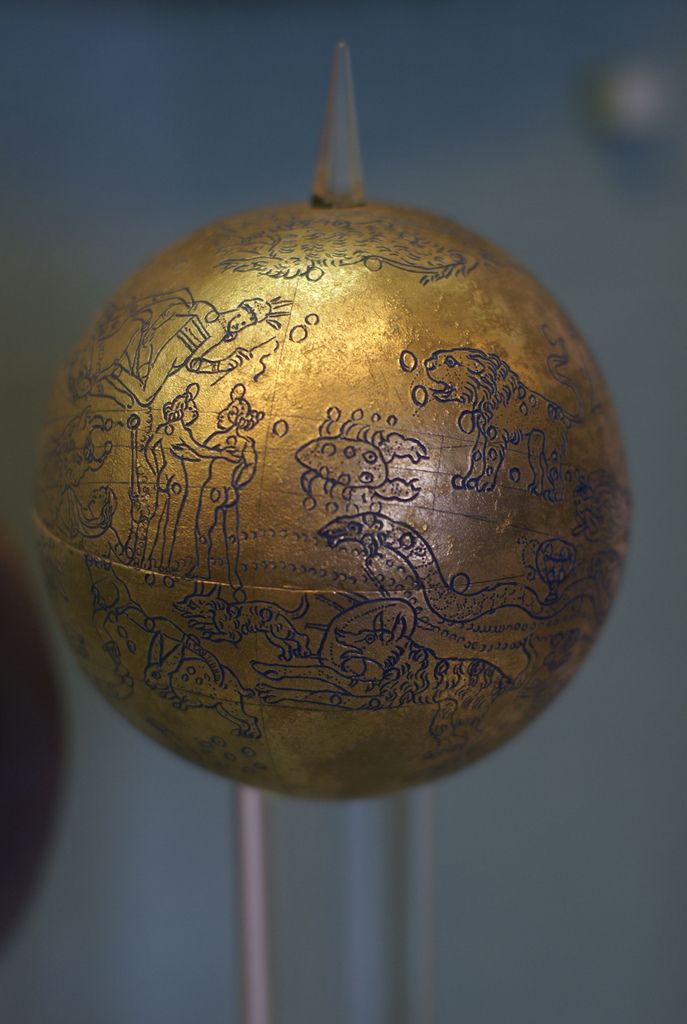
An epitome of Ario Didymus presents particular interest in the theme of the conformation of the World. For Didymus, the World is the union of gods and men, and of all things produced for them.
According to Chrysippus, the world is the union that heaven and earth form with the species of beings they contain or the union which gods and men form and all that has been produced for the good of these two classes of beings. In another sense, it is God who is called the world, God by virtue of whom the beautiful order of the world is formed and fulfilled.
Then he continues:
Considered according to this beautiful order, the world comprises a part that moves in a circle around the center and an immobile part; the part that moves in a circle is the ether, the immobile part is the earth, the masses of water that cover it, and the air. The most compact element of matter is naturally the foundation of the whole, in the same way, that, in a living being, bones: this element is called the earth. The water spreads circularly all around the earth; its characteristic is to keep itself everywhere at a very equal level.
It then describes the earth and the other elements that make up the lower part of the World, its foundation:
Instead, the earth has prominences which, in some places, protrude through the water in the direction of height: they are called islands, and those which extend more widely are called continents, because of the ignorance in which one is of what they are, they are also bathed by vast seas. In immediate contiguity with the water, there is the air which is like an evaporation of it and which is circulated circularly all around it, then, in contiguity with the air, the ether, the thinnest element and the purest.
Finally, here he is sketching his image of the sky:
These are therefore the elements into which the World, considered a beautiful order, is divided, while the part that moves in a circle around it is the ether, where the stars are placed – both the fixed stars and the planets – which, by nature, they are divine, soulful and ruled by Providence. The multitude of fixed stars is innumerable: as for the planets, they are seven in number, all less elevated than the fixed stars. The fixed stars are all located on the same plane, as it is easy to see, while each of the planets is assigned a different sphere: all these planetary spheres are surrounded by fixed stars. The highest of them after the sphere of the fixed stars is that of Saturn, after this comes that of Jupiter, then that of Mars, then that of Mercury, after that of Venus, then that of Sun, and finally, to the end of the series, that of the Moon bordering the air: it also appears of a more aeriform nature and exerts greater influence on earthly things. Under the moon comes the sphere of air which is moved by the ether, then that of water, and finally that of the earth located in the central point of the world, which represents the bottom of the universe, while the upper part is made up of what, from this point, it extends in all directions in a circle.
THE WORLD OF CICERO
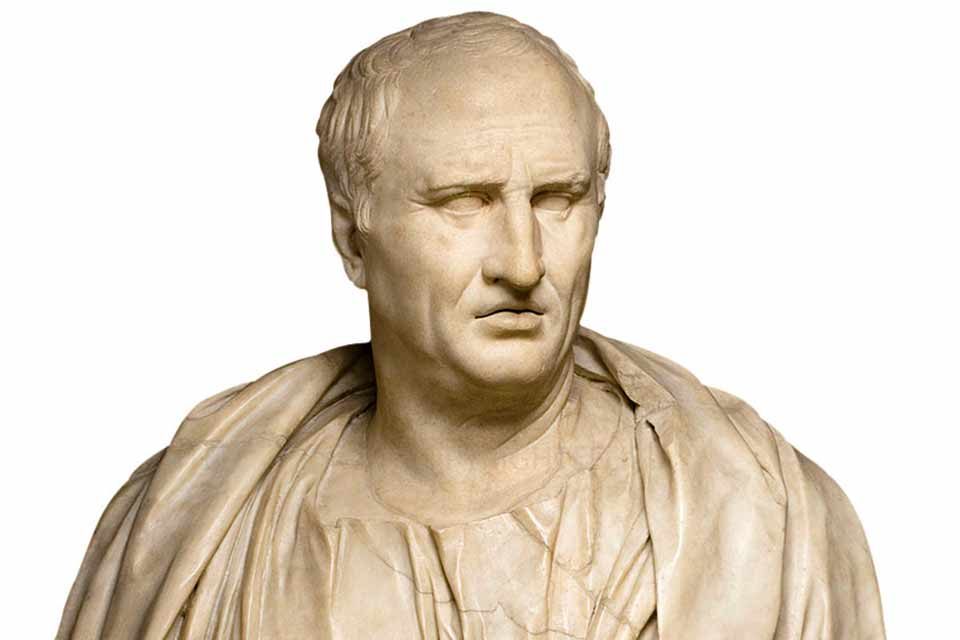
Cicero’s Sleep of Scipio, is an essential text for our study.
Then the African said: “I see that you still contemplate the seat and the abode of men; but if it really seems so small to you, which it actually is, never stop keeping your gaze fixed on celestial things and despise human ones. In fact, what celebrity can you ever achieve in people’s speeches, what glory is worth seeking out? You see that on earth people live in scattered and restricted areas and that this sort of patches in which they live are interspersed with enormous deserts; moreover, the inhabitants of the earth are not only separated to the point that, between them, nothing can spread from one to the other, but some are arranged, with respect to you, in an oblique direction, others transversely, still others are actually at the antipodes. You certainly cannot expect glory from them.”
Below, Cicero presents a representation of the earth divided into two bands (not two hemispheres), under the dome of the sky constituting part of the globe of the world.
He also notes that the earth is in a certain sense crowned and wrapped in bands: two of them, diametrically opposite and resting, on their respective sides, at the very vertices of the sky, stiffen due to the frost, while the central band, over there, the largest, is burned by the blaze of the sun. Inside, there are two habitable areas: the southern region, there, where the inhabitants leave footprints opposite to yours, has nothing to do with your race; as for this other one, instead, that you live in, exposed to a kite, look at how it touches you only to a minimal extent. As a whole, in fact, the land that is inhabited by you, narrow at the top, wider at the sides, is, as it were, a small island surrounded by that sea that on earth you call the Atlantic, the Great Sea, the Ocean, but which, in spite of the high-sounding name, you can see how tiny it is.
The world that Scipio sees in a dream is a sphere, which at its center has a temple called Terra: “Men were, in fact, generated with the following commitment, to keep that sphere there, which you see at the center of this celestial temple called Terra“. Elsewhere, in the Tusculane, Cicero describes the terrestrial globe “As fixed in the middle of the world, rising from the sea”.
The image of the World as a (celestial) Temple finally lets the ancient Orphic doctrines resound in the Sleep of Scipio:
“No” he replied. “If that god to whom all the celestial temples you see belongs has not freed you from the prison of the body, it cannot happen that access to this place is practicable for you.”
THE WORLD TEMPLE OF GOD
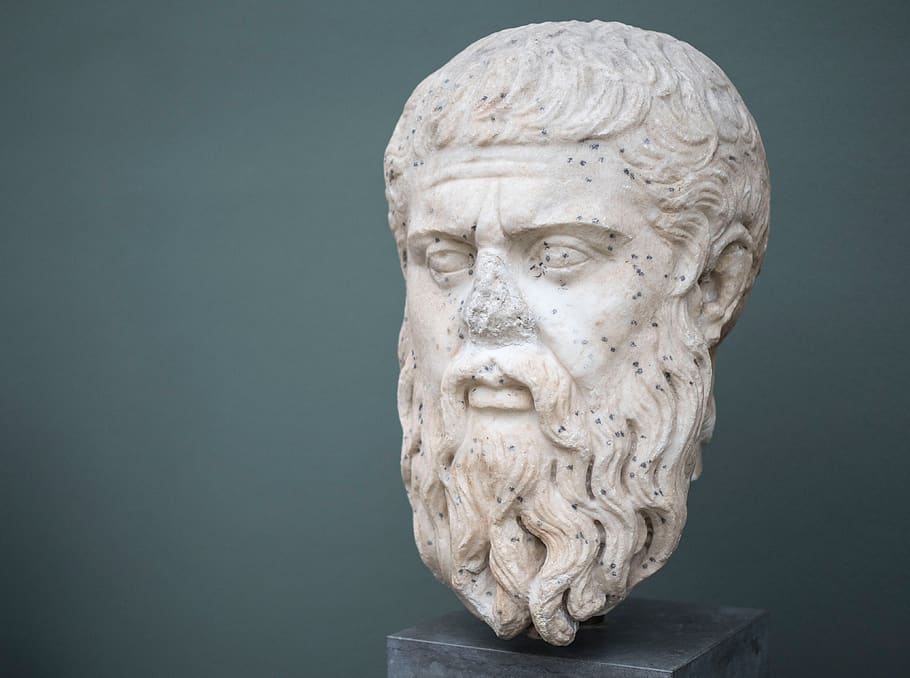
In the Introduction of Manilio’s Astronomica there are these beautiful verses:
bina mihi positis lucent altaria flammis, ad duo templa precor duplici circumdatus aestu carminis et rerum: certo cum lege canentem mundus et immaculate vatem circumstrepit orbe vixque soluta suis inmittit verba figuris,
or “two altars shine with flames lit by me; before two temples I pray, agitated by a double ardor: for poetry and for the theme. And around the Poet who sings following his rigorous laws, the World also resounds in its immense circle, with difficulty letting the words adapt to its forms”.
Festugiere comments on the passage as follows: “At the moment of singing the sky and its divine inhabitants, – a difficult task twice, both for the difficulties of the verse and for those of the subject, the poet does not go alone, according to the ancient custom of the time, to the sanctuary of the Muses of the Helicon (primusque novis Helicona movere | cantibus, I 4), but he goes to pray in the temple of the World. In fact, the World is also a sanctuary, and Manilius is its priest (vates). He feels all penetrated by a sacred fear. Around him, the immense sphere of the Universe whirls around. How to celebrate such a great being without a special favor from Heaven itself. Science and prayer are closely linked here, and it is the constant influence of a truly religious breath in the entire course of the Astronomica that makes the greatness of the poem.”
But not only is the World a Temple, the World, Kosmos, as we will see shortly in Hermes, is itself a God. See this passage from Philo:
It is in a very pious and very holy way, it seems to me, that Aristotle , fighting this opinion, “declared that the Kosmos is unbegotten and indestructible. As for those who hold the contrary opinion, he accused them of a monstrous atheism,” for having dared to compare to the works made by human hand such an immense visible god, who truly embraces in himself the Sun, the Moon and this “pantheon” of the other stars, planets and fixed stars.
Speaking of this, with a blatant mockery of these ungodly, Aristotle adds: “In the past, I was concerned only for my home, I feared that, due to the violence of the winds or storms, or the wear and tear of time, or because we would have neglected to take appropriate care of it, it would come to collapse: but now there is a much greater danger that threatens us because of those who, with their theories, demolish the whole Kosmos factory.
In the Platonic Epinomides as well as in Aristotle and, a fortiori, in subsequent writings, the religion of the World manifests a common trait: the doctrine of intelligible is neglected.
This entails an implication: the visible World is no longer considered as the image of another World, the final object of contemplation, but itself becomes its object, it is to it that the worship of the sage is addressed.
In essence, this is the religion of the World.
The World is in motion, but it is ordered, and from this order comes the proof of the existence of a Soul of the World, of an Intellect that governs it, of a cosmic God.
The sensitive universe and the intelligible whole will also be different things for Plato, but the visible Heaven and the divine Soul that moves the Whole are not so different.
Although many of these ideas have been attributed to the Stoics, Plato provided most of the elements with his Epinomides. Aristotle then drew the first features of the religion of the world.
To the question “What is Wisdom and which science leads to it?”, Plato, in Epinomides, gives this answer: “Wisdom, which is piety, consists in the science of the stars or astronomy”.
Adoration is no longer addressed to the intelligible, but to the visible World as an organic expression of a divine Intellect (nous).
In the religion of the World, in other words, the living World is worshiped, as endowed with a Soul, the Soul Mundi?
The thrice great Hermes wrote against the religion of the world :
“Who then is this material god?” « It is the World, but it is not good, as it is material and is easily subject to affections, and indeed it is the first of all passable beings, the second of beings in general, and incomplete in itself; he began to live at a certain moment, but he is destined to exist forever; it subsists in becoming and is always becoming, source of becoming of qualities and quantities. Indeed, it is in motion, and every material movement is becoming.
Plato seems to respond to this almost Gnostic conception of the World as negativity subject to affection. The visible world is not the image of another world, the final object of contemplation, but the worship of the sage must be addressed to it, since, as immortal, it cannot be evil.
___
Finally, it is worth mentioning, in relation to the Mundus, Cicero’s controversy against Aristotle :
Aristotle in his third book On Philosophy confuses together many concepts in controversy with his teacher Plato. Now he attributes divine nature to the intellect alone, now he identifies divinity with the World, now he presents to the World a being distinct from it and assigns it the functions of regulator and conservator of universal motion through a sort of reverse rotation, now he divinizes the celestial fire, without realizing that the sky is only a part of that World that in other passages he has defined as a god. On the other hand, in the midst of such a rapid movement, how can this alleged divine consciousness remain equal to itself, with which heaven would like to be endowed? Where will such a large number of gods find a place if we include the sky among the gods? It should be added that this same thinker makes divinity an incorporeal being and therefore excludes that it can perceive reality and, consequently, regulate its action with prudent wisdom. Furthermore, how could an incorporeal World move or, always moving, be serene and happy?
THE FORMATION OF THE WORLD ACCORDING TO PLATO
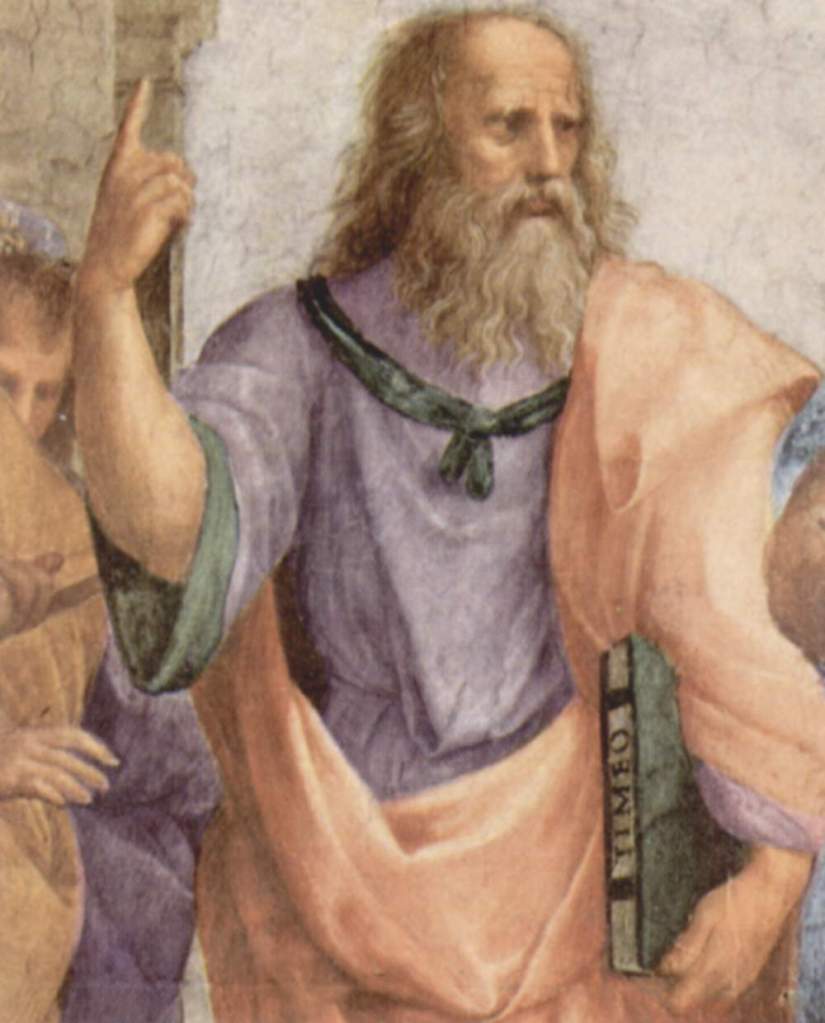
On the composition of the World, Plato in the Timaeus argued that a living being that contained all living beings within itself was suitable a form that was to contain all forms. Therefore, he rounded it into the shape of a sphere, equally distant in every point from the center to its extremities, in a circular orbit, which is the most perfect and the most similar to itself of all forms, having thought that the like was of great long more beautiful than unlike.
(…) Such was the reasoning that the god who always is formulated regarding the god he would one day be, and so made a smooth and uniform body, in every point equally distant from the center, and whole and perfect and composed of bodies perfect: and placed the soul in the midst of it, he tried to spread it in every direction, and even covered the body with it from the outside, and created a circular Heaven that moves all around, unique and deserted, by its virtue is able to take care of himself and not needing anyone else, good connoisseur and friend of himself” (…) In the crater […] in which he had tempered and mixed the soul of the universe, he poured the things that were left over from those used before.[…].
In the Phaedo, Plato has Socrates say that “the Earth is at the center of the universe and is round and that, in order not to fall, it needs neither air nor any other support of the kind; but what suffices to support it is the constant homogeneity of the universe and the perfect balance of the Earth itself. In fact, a balanced thing, placed in the center of a homogeneous substance, will never be able to lean anywhere, either a little or a lot, but, being itself homogeneous, it will remain motionless…”
AURELIO BRUNO
(themes drawn from Aurelio Bruno, “The Pantheon of the Sky, 2022, ISBN: 979-8370654237)
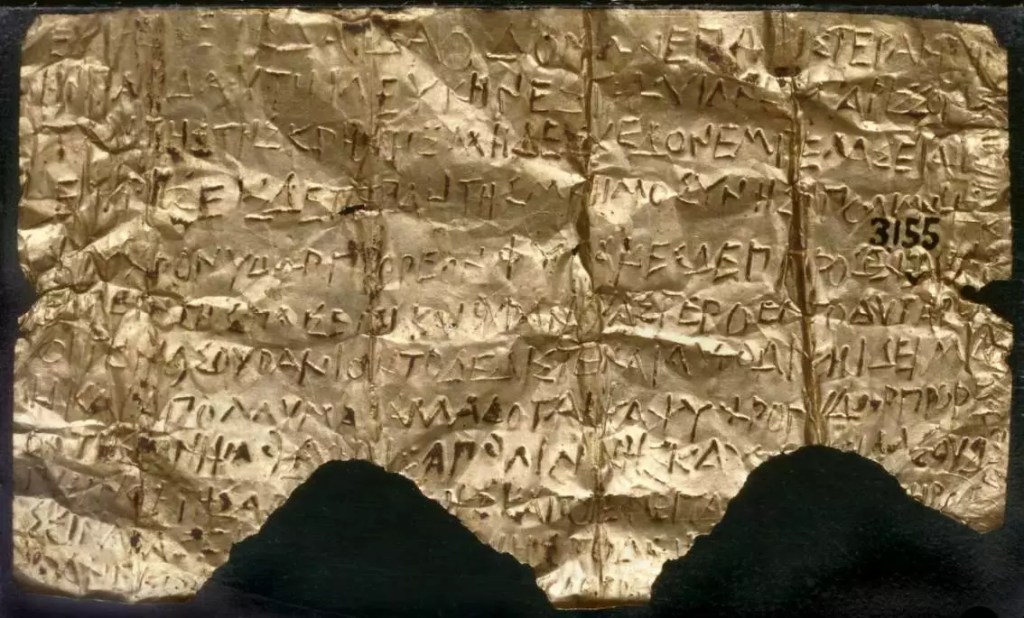
I am a child of the Earth and of the starry sky,
I’m of celestial race, know that…
(Orphic gold plate of Petelia, British Musem)
Disclaimer
Last updated: February 26, 2023
Interpretation and Definitions
Interpretation
The words of which the initial letter is capitalized have meanings defined under the following conditions. The following definitions shall have the same meaning regardless of whether they appear in singular or in plural.
Definitions
For the purposes of this Disclaimer:
- Company (referred to as either “the Company”, “We”, “Us” or “Our” in this Disclaimer) refers to Il Pantheon del Cielo.
- Service refers to the Website.
- You means the individual accessing the Service, or the company, or other legal entity on behalf of which such individual is accessing or using the Service, as applicable.
- Website refers to Il Pantheon del Cielo, accessible from www.pantheondecoded.org
Disclaimer
The information contained on the Service is for general information purposes only.
The Company assumes no responsibility for errors or omissions in the contents of the Service.
In no event shall the Company be liable for any special, direct, indirect, consequential, or incidental damages or any damages whatsoever, whether in an action of contract, negligence or other tort, arising out of or in connection with the use of the Service or the contents of the Service. The Company reserves the right to make additions, deletions, or modifications to the contents on the Service at any time without prior notice. This Disclaimer has been created with the help of the TermsFeed Disclaimer Generator.
The Company does not warrant that the Service is free of viruses or other harmful components.
External Links Disclaimer
The Service may contain links to external websites that are not provided or maintained by or in any way affiliated with the Company.
Please note that the Company does not guarantee the accuracy, relevance, timeliness, or completeness of any information on these external websites.
Errors and Omissions Disclaimer
The information given by the Service is for general guidance on matters of interest only. Even if the Company takes every precaution to insure that the content of the Service is both current and accurate, errors can occur. Plus, given the changing nature of laws, rules and regulations, there may be delays, omissions or inaccuracies in the information contained on the Service.
The Company is not responsible for any errors or omissions, or for the results obtained from the use of this information.
Fair Use Disclaimer
The Company may use copyrighted material which has not always been specifically authorized by the copyright owner. The Company is making such material available for criticism, comment, news reporting, teaching, scholarship, or research.
The Company believes this constitutes a “fair use” of any such copyrighted material as provided for in section 107 of the United States Copyright law.
If You wish to use copyrighted material from the Service for your own purposes that go beyond fair use, You must obtain permission from the copyright owner.
Views Expressed Disclaimer
The Service may contain views and opinions which are those of the authors and do not necessarily reflect the official policy or position of any other author, agency, organization, employer or company, including the Company.
Comments published by users are their sole responsibility and the users will take full responsibility, liability and blame for any libel or litigation that results from something written in or as a direct result of something written in a comment. The Company is not liable for any comment published by users and reserves the right to delete any comment for any reason whatsoever.
No Responsibility Disclaimer
The information on the Service is provided with the understanding that the Company is not herein engaged in rendering legal, accounting, tax, or other professional advice and services. As such, it should not be used as a substitute for consultation with professional accounting, tax, legal or other competent advisers.
In no event shall the Company or its suppliers be liable for any special, incidental, indirect, or consequential damages whatsoever arising out of or in connection with your access or use or inability to access or use the Service.
“Use at Your Own Risk” Disclaimer
All information in the Service is provided “as is”, with no guarantee of completeness, accuracy, timeliness or of the results obtained from the use of this information, and without warranty of any kind, express or implied, including, but not limited to warranties of performance, merchantability and fitness for a particular purpose.
The Company will not be liable to You or anyone else for any decision made or action taken in reliance on the information given by the Service or for any consequential, special or similar damages, even if advised of the possibility of such damages.
Contact Us
If you have any questions about this Disclaimer, You can contact Us:
- By email: pantheondecoded@gmail.com
 Il Pantheon del Cielo